About Chrysuronia coeruleogularis (Gould, 1851)
Scientific Nomenclature
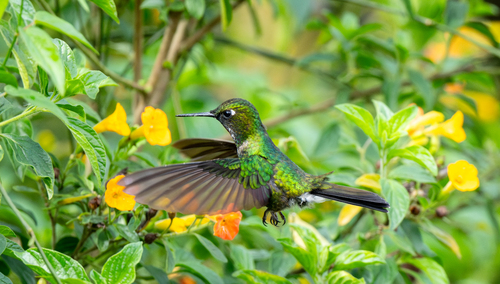
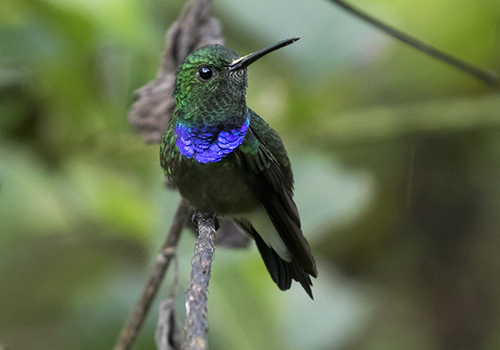
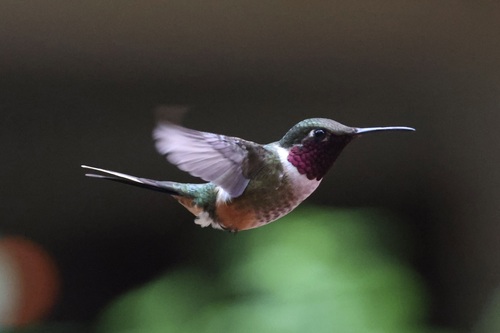
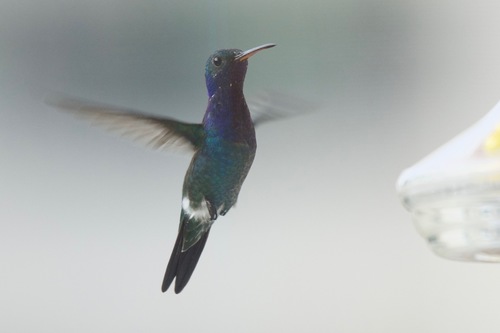
The sapphire-throated hummingbird, Chrysuronia coeruleogularis, has full shiny metallic-green plumage, with darker wings and tail.
Sexual Plumage Dimorphism
Males have a broad, glistening blue patch on the throat, while females have a white throat patch and distinct green spots along the sides of the breast.
Tail Morphology
The tail is deeply notched and tipped with black.
Size and Weight
This is a small hummingbird, measuring 8.5–9.5 cm (3.3–3.7 in) in length and weighing 4–4.5 grams (0.14–0.16 oz).
Bill Morphology
Males have a short, straight bill: the upper mandible is black, and the lower mandible is pinkish with a black tip.
Subspecies Throat Variation
Three subspecies are recognized, each with differences in throat patch color: the nominate subspecies Chrysuronia coeruleogularis coeruleogularis has a darker throat patch, Chrysuronia coeruleogularis conifis has a more turquoise throat tone, and Chrysuronia coeruleogularis coelina has a lighter blue throat tone.
Similar Congeneric Species
This species is often confused with other members of its genus, including the sapphire-bellied hummingbird (Chrysuronia lilliae) and the shining-green hummingbird (Chrysuronia goudoti).
Sapphire-Bellied Hummingbird Distinction
Male sapphire-bellied hummingbirds differ from sapphire-throated hummingbirds by having darker shiny blue throat color that covers the entire ventral side, except for the white undertail.
Shining-Green Hummingbird Distinction
The shining-green hummingbird differs by having very little to no blue plumage, unlike the other two species.
Total Distribution Size
The sapphire-throated hummingbird has a large range with an estimated distribution size of 88,900 km².
Global Population Status
The global population size has not been quantified, and the population is described as patchy.
Overall Country Range
It is found across Panama, Colombia, and most recently Costa Rica.
Subspecies Geographic Ranges
Each subspecies has a distinct range: the nominate subspecies occurs in Pacific western Panama, ranging from Chiriquí to the Canal Zone; Chrysuronia coeruleogularis confinis occurs on the Caribbean slope of eastern Panama and northwestern Colombia; and Chrysuronia coeruleogularis coelina occurs in northern Colombia, from northern Chocó through Ciénaga Grande de Santa Marta.
2008 Costa Rica Discovery
In 2008, a male sapphire-throated hummingbird was discovered in Costa Rica 35 kilometers north of the Panamanian border, suggesting the species is slowly dispersing northward to establish new territories.
1962 Costa Rica Record
An unconfirmed 1962 record from Costa Rica was originally thought to come from a mislabeled specimen, but was later confirmed to be a sapphire-throated hummingbird.
Habitat Types
The sapphire-throated hummingbird occurs most commonly in coastal forests, and also occupies secondary forests and scrubby clearings, and less frequently mangrove patches.
Habitat Preference and Modified Habitats
It prefers light forests and forest edges over dense forests, and has been recorded using modified habitats, including protected areas such as Colombia's Tayrona National Natural Park.
Elevation Range
It can be found at elevations up to 100 m above mean sea level.