About Veronica odora Hook.fil.
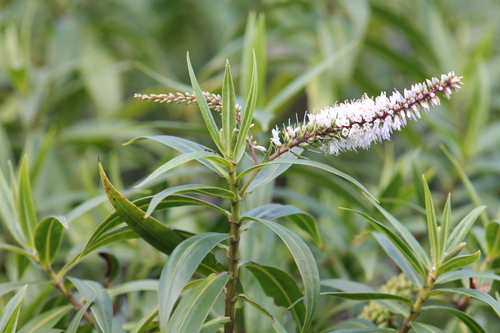
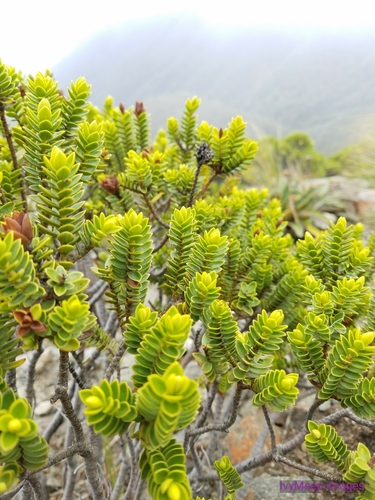
Veronica odora Hook.fil. is an easily recognizable, round, spherical, evergreen shrub. Its Buxus-like foliage gave this plant the common name boxwood. Veronica odora grows slowly. It typically reaches around 1 m in height, but can grow to 1.5 m or even taller in suitable environments. Its leaves are elliptic-ovate, growing in a compact, dense, upright arrangement; they measure 1–2 cm long and 4–10 mm wide. The foliage is generally dark green and corticate. The upper leaf surface is dark green, smooth, and shiny, while the lower surface is dull and pale. There is a small gap at the base of leaf buds. Young branches are usually green to yellowish green, and leaf buds are distinctly heart-shaped or shield-shaped. Leaf blades have noticeable bevelled edges; the midrib is prominent on the lower leaf surface, and the leaf base has a clear protrusion. Inflorescences are most often terminal, with one or two pairs of lateral spikes; sometimes there is only a single spike, which may be terminal or lateral. The peduncle is short and often hidden by leaves. This inflorescence growth habit means most Veronica odora develop conical flower heads. Veronica odora is a native plant of New Zealand, where it is widely distributed across the North Island, South Island, Stewart Island, and Auckland Island. It is common in subalpine to low mountain areas south of Hikurangi Mountain, growing in humid environments at altitudes between 600 and 1400 meters, but is rare within forests. It typically occurs in subalpine shrubs and mixed snow grass, and sometimes extends into snow grass grassland. It can also be found growing on riverbanks, cliffs, and ridges. It is also present in urban environments, where some people grow it in home gardens due to its cold hardiness and ease of cultivation. Veronica odora is very common in cultivation. It usually produces white flowers between October (mid spring) and March (early autumn). Despite its species epithet odora meaning fragrant, this species has no scent. It fruits between December and April. It has two methods of propagation. One is seed dispersal by wind, but its seeds are very fragile and cannot be stored for long periods. Autumn is the best time to sow Veronica odora. Seeds must be sited in a location not exposed to direct sunlight, and require an optimal germination temperature of 12 to 15 °C. When these conditions are met, seeds will generally germinate the following spring. The other propagation method is cutting. For this method, 10–12 cm long branches are transplanted into soft soil in spring. The growing tip can be removed to encourage bushier growth. A low temperature of 12–15 °C is ideal for cutting growth; higher temperatures can cause cuttings to rot or dry out. Selection of appropriate cuttings is important: old wood, damaged branches, disease- or pest-damaged growth, and branches from plants with poor flowering or poor growth should not be used. Cuttings should be taken from actively growing branches, and should not include the growing bud under the stem. For successful rooting, cuttings should be taken from twigs that are not overly soft, as very soft twigs will wilt.