About Ourisia caespitosa Hook.fil.
Growth Form
Ourisia caespitosa Hook.fil. are perennial herbaceous plants. Their stems are creeping, heavily branched, and densely covered with creeping opposite leaves.
Leaf Petiole Size
Leaf petioles measure 0.8–9.4 mm in length.
Leaf Blade Dimensions
Leaf blades are 1.9–9.4 mm long by 1.1–6.3 mm wide, with a length-to-width ratio of 1.2–2.0:1.
Leaf Blade Shape and Margin
Blades are usually narrowly to broadly ovate or obovate, widest either below or above the middle, with a rounded apex, cuneate base, and are either trilobed or marked with up to 4 irregular notches or teeth.
Leaf Surface Characteristics
Leaves are mostly glabrous, and have dense punctation on their lower surface.
Inflorescence Structure
Inflorescences are erect, glabrous racemes that reach up to 125 mm (4.9 in) in length, holding 1–3 flowering nodes and up to 6 total flowers per raceme.
Flowering Node Bracts
Each flowering node produces 1–2 flowers and 2 sessile, clasping bracts that are usually narrowly to broadly ovate or obovate. The lowest bracts are similar in size and shape to the plant’s leaves, measuring 3.1–8.2 mm long and 1.4–6.3 mm wide, and bracts get smaller toward the tip of the raceme.
Pedicel Characteristics
Flowers grow from glabrous pedicels that reach up to 32 mm long.
Calyx Morphology
The calyx is 4.3–7.4 mm long, irregular in shape: three of its lobes are divided to roughly one-quarter of the calyx’s total length, while two are divided nearly to the base, and the calyx is usually glabrous.
Corolla Overall Structure
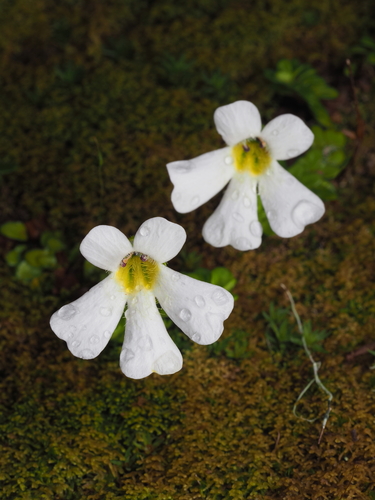
The corolla is 11.3–19.3 mm long (including a 3.9–9.7 mm long corolla tube), white, bilabiate, and tubular-funnelform. It is glabrous on the outside, and has three lines of yellow hairs on the inside.
Corolla Lobe Characteristics
Corolla lobes are 3.5–10.9 mm long, spreading, and shaped obovate to obcordate.
Stamen Morphology
This species has 4 didynamous stamens that reach up to 8.3 mm long: two long stamens extend outside the corolla, while two short stamens remain enclosed inside it. A short staminode up to 4 mm long is also present.
Style and Stigma Characteristics
The style is 4.4–7.6 mm long, extends outside the corolla, and ends in a capitate stigma.
Ovary Characteristics
The ovary is 1.8–4.0 mm long and glabrous.
Fruit Characteristics
Fruits are capsules 4.2–6.8 mm long and 2.6–4.8 mm wide, that open via loculicidal dehiscence, and sit on pedicels up to 21.0 mm long. Each capsule holds roughly 160 tiny seeds.
Seed Characteristics
Seeds are 0.6–1.0 mm long and 0.4–0.6 mm wide, rectangular, linear oblong or narrowly oblong, with a two-layered, reticulate seed coat.
Flowering and Fruiting Period
Ourisia caespitosa flowers from October to March and fruits from December to April.
Elevational Flowering Variation
In Cupola Basin, Nelson Lakes National Park, this species was recorded as one of eight widespread species where populations growing at higher elevations flower 3–5 weeks earlier than populations growing at lower elevations.
Chromosome Number
The chromosome number of Ourisia caespitosa is 2n=48.
Endemic Range
This New Zealand foxglove is endemic to the North, South and Stewart Islands of New Zealand. It is widespread and common across most high-elevation areas.
North Island Distribution
In the North Island, it occurs in the Gisborne, Volcanic Plateau and Southern North Island regions.
South Island Distribution
On the South Island, it is widespread across all regions.
Stewart Island Distribution
On Stewart Island, it has only been recorded from Mount Anglem / Hananui.
Habitat Types
It grows in herbfields, grasslands and scrub located above the bush line, most often in damp locations.
Substrate and Elevation Range
It can be found growing on shingle, scree, rocks, crevices, outcrops and cliffs, at elevations ranging from 540 to 2,000 metres (1,770 to 6,560 ft) above sea level.