About Callitriche muelleri Sond.
Scientific Name
Callitriche muelleri Sond.
Distribution
New Zealand Range
Callitriche muelleri is a native species. It is widespread across much of New Zealand's North Island and the northwest of the South Island. It also reaches the Kermadec Islands (Raoul Island) and Rekohu (Chatham Island).
Australian Range
In Australia, it is found throughout the coastal parts of eastern Australia, from Gympie south and west to the Great Otway National Park in Victoria. There are disjunct occurrences in Queensland, including the Atherton Tableland and Carnarvon Gorge.
Extra Range Records
Isolated records also exist from New Caledonia.
Illustrations
Refer to Figures 1 (a – b) and 1 A (a – c) in Mason 1959; Plates 1 (A – M) and 4 (1 – 4) in Schotsman (1985 c), and Fig. 10 c.
Recognition
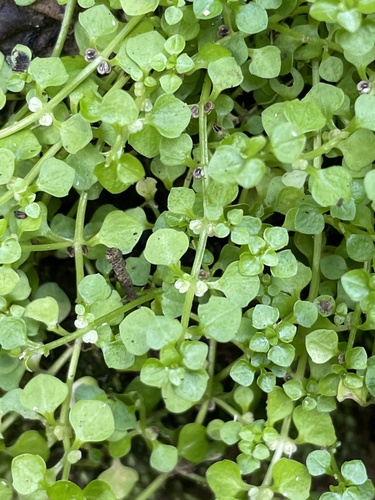
C. muelleri is the only Callitriche species with toothed leaves. Combined with its very broadly - winged fruit, which are reddish - brown or maroon when mature, it is easily distinguishable.
Habitats and Ecology
Substrate Preferences
Throughout its range, Callitriche muelleri typically grows on bare wet mud, loam, or sand, often spreading over adjacent stones, gravel, or leaf litter. It can also be found on thin soil over paving in habitats subject to seasonal inundation and occasionally in shallow water.
Associated Vegetation
It has been recorded growing with a wide variety of species in Australia and New Zealand. It is most frequently found in various forest types, such as rainforest, wet sclerophyll forest, or notophyll rainforest, as well as Melaleuca sp. woodland and humid scrub.
New Zealand Specific Habitat
In New Zealand, it has been recorded from Podocarpus dacrydioides floodplain forest. It grows at an elevation of 8 – 1128 m.
Conservation Status
Global Status
This species is classified as Least Concern (IUCN 2012) as it is widespread, has stable populations, and faces no major threats.
New Zealand Status
In New Zealand, it is classed as Not Threatened, Secure Overseas (de Lange et al. 2018).
Additional material studied
Detailed information on specimens from Australia (New South Wales, Queensland, Victoria), New Caledonia, and New Zealand (including Chatham Island, Kermadec Island, North Island, and South Island) is provided, including collection dates, collectors, and specimen numbers.