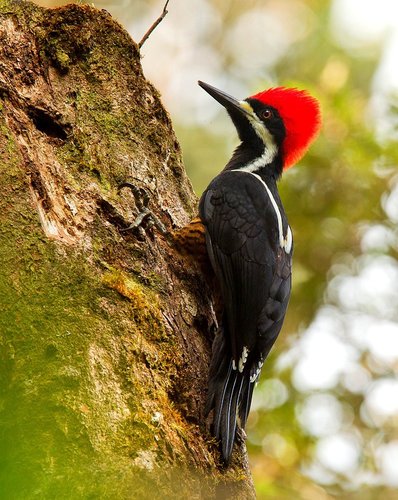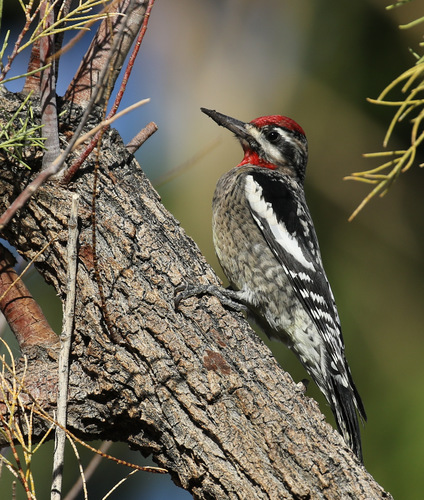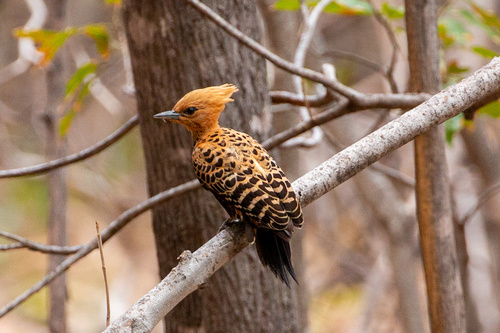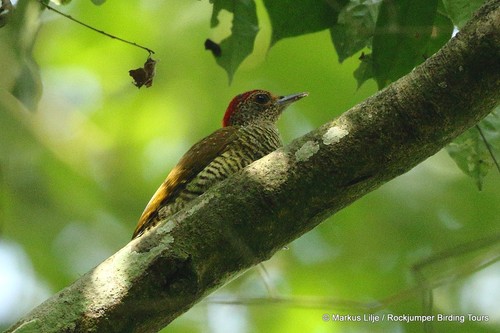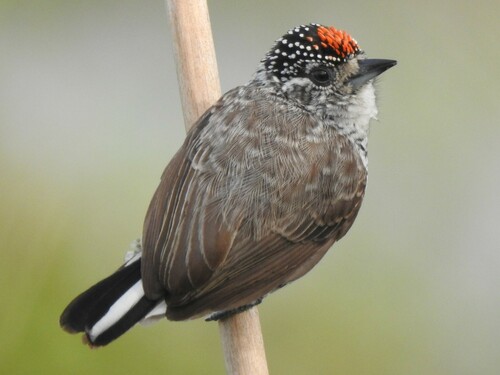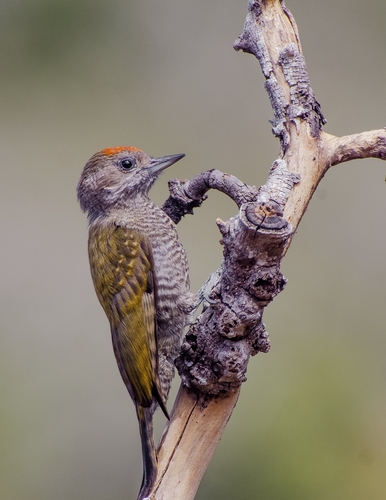
About Veniliornis passerinus (Linnaeus, 1766)
Common Name and Size
Veniliornis passerinus, commonly called the little woodpecker, is about 14 to 15 cm (5.5 to 5.9 in) long and weighs 24 to 37 g (0.85 to 1.3 oz).
Sexual Plumage Difference
Males and females have identical plumage everywhere except their heads.
Nominate Male Head Plumage
Nominate subspecies V. p. passerinus males have a red forehead, crown, and nape, with dark feather bases visible through the red.
Nominate Female Head Plumage
In the areas where males are red, females are grayish olive-brown with faint indistinct white spots.
Adult Facial and Throat Plumage
Adult individuals of both sexes have a mostly dark brownish-olive face, with pale barring on the chin and throat.
Upperparts Plumage
Their upperparts are mostly bronzy olive-green with red feather tips, and pale barring on the rump.
Flight Feather Plumage
Their flight feathers are brown with green edges, and moderately narrow whitish bars on the primaries and secondaries.
Wing Coverts Plumage
Small pale spots mark their wing coverts.
Tail Plumage
Their tail is dark brown with thin pale bars on the outer feathers.
Underparts Plumage
Their underparts are dark olive with narrow buffish white bars.
Bare Parts Features
The iris is deep brown, the moderately long beak is blackish with a paler lower mandible, and the legs are dark gray.
Juvenile Plumage
Juveniles are duller than adults, have less bronzy upperparts, and less regular barring on their underparts. Both juvenile sexes have some red on the crown, with males having more red than females.
Subspecies Variation Overview
Other subspecies differ from the nominate and one another, though they tend to intergrade.
Subspecies modestus Features
Subspecies modestus has a white "moustache", obvious spots on the wing coverts, and gray-brown underparts with irregular barring.
Subspecies fidelis Features
Subspecies fidelis has a pale supercilium, a large white moustache, large spots on the wing coverts, broken or scallop-shaped underpart barring, and usually has no bars on the tail.
Subspecies diversus Features
Subspecies diversus has faint or no facial stripes, very pale thin streaks on the wing coverts, and wide bars on the underparts; in this subspecies, males only have red from the central crown to the hindneck.
Subspecies agilis Features
Subspecies agilis has well-developed supercilium and moustache lines.
Subspecies insignis Features
Subspecies insignis is the smallest subspecies; it has no facial stripes, no wing covert spots, and wide pale stripes on the underparts. Males of this subspecies only have red from the central crown to the hindneck.
Subspecies tapajozensis Features
Subspecies tapajozensis has upperparts with a yellow tinge and some red spots.
Subspecies taenionotus Features
Subspecies taenionotus has yellower upperparts than tapajozensis with hints of barring, large wing covert spots, and very wide pale bars on the underparts.
Subspecies olivinus Features
Subspecies olivinus is the largest subspecies. It sometimes has a pale supercilium and moustache; males of this subspecies only have red on the hindcrown and nape.
Subspecies Distributions
Different subspecies of the little woodpecker occupy distinct ranges: V. p. fidelis is found in eastern Colombia and western Venezuela; V. p. modestus is found in central and northeastern Venezuela; V. p. diversus is found in northern Brazil north of the Amazon; V. p. agilis is found in extreme southern Colombia, eastern Ecuador, eastern Peru, western Brazil, and northern Bolivia; V. p. insignis is found in west central Brazil south of the Amazon; V. p. tapajozensis is found in east central Brazil along the lower Amazon; V. p. passerinus is listed as occurring in the Guianas and northeastern Brazil; V. p. taenionotus is found in eastern Brazil; V. p. olivinus is found in southeastern Bolivia, southern Brazil, eastern Paraguay, and northwestern and northeastern Argentina.
Nominate Subspecies Range Note
Regarding V. p. passerinus' range, the International Ornithological Congress and Clements checklist list it as present in the Guianas, but the South American Classification Committee of the American Ornithological Society has no records of this subspecies in Suriname.
Habitat Preferences
The little woodpecker lives in a wide variety of landscapes, and generally avoids closed forest interiors. It most often occurs along the edges of cloudforest, várzea forest, and riparian forest.
Additional Habitat Types
It can also be found in gallery forest with bamboo stands, deciduous woodland, mangroves, secondary forest, wooded savanna, and caatinga.
Elevation Range
Its elevation range varies across its distribution: it occurs from sea level along the Atlantic coast, up to 850 m (2,800 ft) in Venezuela, up to 1,200 m (3,900 ft) in Colombia, up to 1,300 m (4,300 ft) in Ecuador (though it usually stays below 700 m (2,300 ft) there), up to 900 m (3,000 ft) in Peru, and up to 400 m (1,300 ft) in the southern portion of its range.