About Sphyrapicus nuchalis S.F.Baird, 1858
Taxonomy and Classification
The red-naped sapsucker, scientifically named Sphyrapicus nuchalis S.F.Baird, 1858, is a medium-sized woodpecker.
Size Measurements
It measures 19–21 cm (7.5–8.3 in) in length and weighs 32–66 g (1.1–2.3 oz).
Head and Ventral Plumage
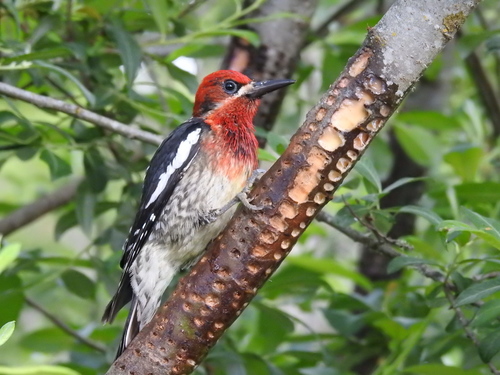
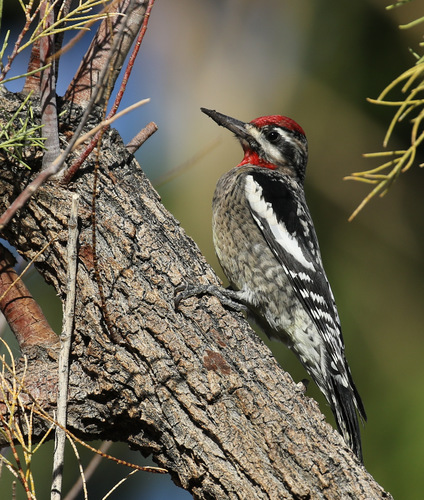
Adult red-naped sapsuckers have a black head with a red forehead, white stripes, and a red spot on the nape, along with a white lower belly and rump. Their breast and upper belly are yellow.
Dorsal and Wing Plumage
Their back and wings are black with white bars, and they have a large white wing patch.
Sexual Dimorphism
Adult males have a fully red throat patch, while females have red on the lower throat and white on the upper throat.
Breeding Range and Habitat
Their breeding habitat consists of mixed forests located in the Rocky Mountains and Great Basin regions of North America.
Nesting Behavior
They build their nests inside cavities in dead trees. Many other tree-cavity nesting species reuse old nesting cavities left by red-naped sapsuckers.
Forest Management Guidelines
Forest management objectives for public land include retaining snags and live trees, in order to provide suitable habitat and foraging opportunities for woodpeckers. Numerous studies confirm that woodpeckers will readily nest in logged areas, as long as some tree stands are left unlogged.
Habitat Threats
Drastic changes to forest habitat from logging and inconsistent tree retention drastically alter the quality of nesting sites and damage the quality of habitat for red-naped sapsuckers.
Migration Pattern
This species migrates south and leaves higher elevation areas when migrating.