About Celeus ochraceus (von Spix, 1824)
Scientific Classification and Size
The ochre-backed woodpecker, scientifically named Celeus ochraceus (von Spix, 1824), measures about 25 to 27 cm (9.8 to 11 inches) in total length.
Sexual Dimorphism in Facial Markings
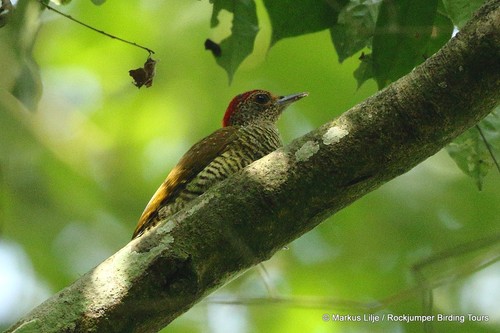
Males have a wide, dull red malar area and cheek, while females have a streaky black malar instead of red.
Head and Neck Coloration
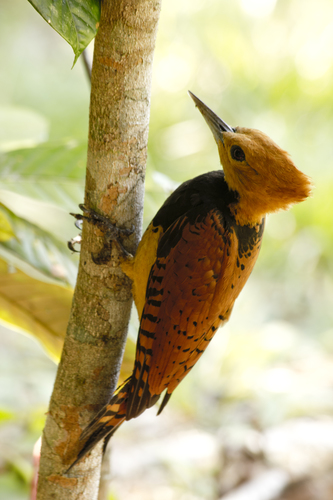
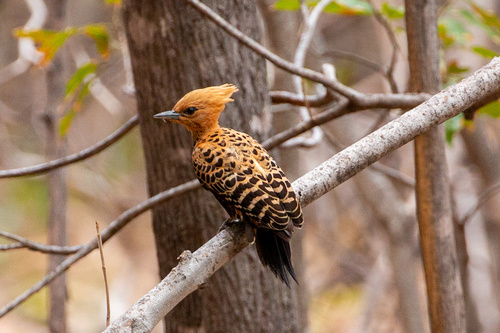
Adult individuals of both sexes have a buffy or cinnamon-tinged ochre head that includes the long pointed crest, chin, throat, and neck.
Upperpart Markings
Their upperparts range from cinnamon-buff to orange-ochre, with black markings that vary in shape from round to heart-like.
Flight Feather Pattern
Most of their flight feathers are primarily black; the secondaries have wide cinnamon-buff bars, and the tertials are cinnamon-buff with black bars and tips.
Tail Feather Appearance
Their tail feathers are black, with pale buffish edges or bars on the outermost pair.
Underpart Markings
Their underparts are sooty, often with buff-cinnamon feather edges, and the rear flanks and undertail coverts have wide cinnamon to buff bars.
Soft Part Coloration
Adult birds have a horn-colored bill, or sometimes a blue-gray to blackish bill with a paler lower mandible; their irises are red or red-brown, and their legs are blue-gray.
Juvenile Appearance
Juveniles are similar in appearance to adults, but are duller overall and have more brownish black coloring on the head.
Distribution Pattern
The ochre-backed woodpecker has a disjunct distribution.
Northern Population Range
One population occurs along the south side of the Amazon River, from western Pará to the Atlantic coast.
Southern Population Range
The second population is located further south, ranging from eastern Maranhão south to Espírito Santo and west to Goiás.
Habitat Preferences
This species inhabits the interior and edges of humid forest, and also occurs in gallery forest, savanna, caatinga, and orchards.