About Picumnus cirratus Temminck, 1825
Nomenclature
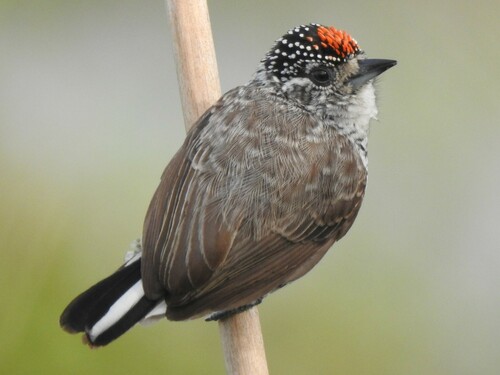
Scientific name: Picumnus cirratus Temminck, 1825, common name: white-barred piculet.
Adult Size and Weight
Adults of this species are approximately 10 cm (3.9 in) long, and weigh 6.3 to 12 g (0.22 to 0.42 oz).
Nominate Male Cap Coloration
For adult males of the nominate subspecies P. c. cirratus, the cap is black with a red patch on the forehead and white spots on the remainder of the cap.
Nominate Male Facial Markings
Their face is mostly dark buff-brown with faint blackish bars, and has a white stripe running behind the eye.
Nominate Male Upperpart Coloration
Their upperparts are dull brownish, and sometimes have faint darker bars.
Nominate Male Flight Feather Features
Their flight feathers are dark brown, with buffish white edges on the secondaries and tertials.
Nominate Male Tail Features
Their tail is dark brown; the innermost pair of tail feathers have mostly white inner webs, and the outer two or three pairs have a white patch near the tip.
Nominate Male Chin and Throat Markings
Their chin and throat feathers range from white to pale buff, and have blackish bars.
Nominate Male Underpart Markings
The rest of their underparts are white with black barring, with a buff tinge across the belly and flanks.
Nominate Male Soft Part Features
Their iris is dark chestnut-brown, their orbital ring is blue-gray, their beak is black with a pale base to the mandible, and their legs are gray.
Adult Female Plumage Distinction
Adult females are identical to males in all aspects except that they do not have red on the forehead.
Juvenile Plumage Characteristics
Juveniles are duller and darker than adults, have an unspotted crown, more obvious barring on the upperparts, and heavier barring on the underparts.
Subspecies P. c. confusus Traits
Subspecies P. c. confusus has a darker face than the nominate subspecies, lacks a white line behind the eye, has brown upperparts, and a heavily barred throat.
Subspecies P. c. macconnelli Traits
Subspecies P. c. macconnelli is similar to P. c. confusus, but has no barring on its upperparts; its face sometimes has white spots, and the throat and breast have heavier barring than P. c. confusus.
Subspecies P. c. thamnophiloides Traits
Subspecies P. c. thamnophiloides has grayish upperparts and fewer markings on the underparts, except for arrowhead-shaped markings on the flanks.
Subspecies P. c. tucumanus Traits
Subspecies P. c. tucumanus has distinctly barred gray-brown upperparts, a buffier throat and breast with more obscure bars than the nominate subspecies, and has less red to no red on the crown.
Subspecies P. c. pilcomayensis Traits
Subspecies P. c. pilcomayensis has grayish upperparts, narrow black and white barring on the underparts, and little to no red on the crown.
Distribution Range Overview
The white-barred piculet has two widely separated distribution ranges, with each subspecies occupying a distinct area.
P. c. macconnelli Distribution
P. c. macconnelli is found in the eastern Amazon Basin of northeastern Brazil, ranging west to the Rio Tapajós.
P. c. confusus Distribution
P. c. confusus is found in southwestern Guyana, French Guiana, and Roraima state in extreme northern Brazil.
P. c. cirratus Distribution
P. c. cirratus is found in southeastern Brazil, from south of Minas Gerais and Espírito Santo south to eastern Paraguay.
P. c. pilcomayensis Distribution
P. c. pilcomayensis ranges from southeastern Bolivia and Paraguay into northeastern Argentina, and is also found in Uruguay.
P. c. tucumanus Distribution
P. c. tucumanus is found in northwestern Argentina.
P. c. thamnophiloides Distribution
P. c. thamnophiloides ranges from southeastern Bolivia to northwestern Argentina.
Habitat Types
This species inhabits a wide variety of landscapes including wet and dry woodland, forest edges, thickets, gallery forest in savannah, scrub, bamboo clumps, várzea, and overgrown parks and gardens.
Elevational Range
It occurs across an elevational range from near sea level to about 2,100 m (6,900 ft).