About Varecia variegata (Kerr, 1792)
Taxonomy and Common Name
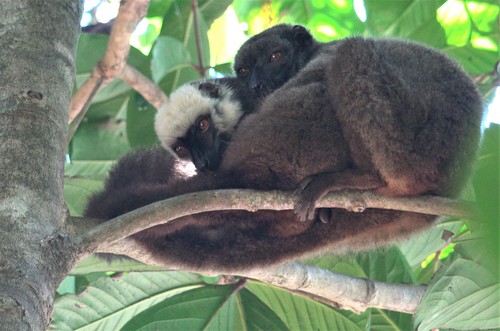
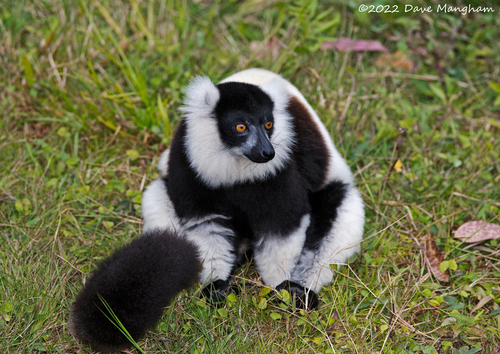
Varecia variegata, the black-and-white ruffed lemur, is the largest extant member of the Lemuridae family alongside the red ruffed lemur.
Size
Its total body length ranges from 100 to 120 cm (3.3 to 3.9 ft), and adult body weight falls between 3.1 and 4.1 kg (6.8 to 9.0 lb).
Coat Coloration
As its common name suggests, this species always has a coat of black and white fur, with general color patterns that typically do not vary.
Color Pattern Details
The abdomen, tail, hands and feet, inner limbs, forehead, face, and crown are black; fur is white on the sides, back, hind limbs, and hindquarters.
Sexual Dimorphism
Males and females have identical appearance.
Geographic Range
This species lives in the eastern rainforests of Madagascar.
Habitat Preferences
It occurs at low to moderate altitudes, primarily in primary forests with tall, mature trees, and prefers dense, contiguous blocks of vegetation, though it will use patchy forests when needed.
Subspecies Distribution
There are three subspecies with slightly different geographic ranges: the white-belted black-and-white ruffed lemur is found furthest north, the southern black-and-white ruffed lemur is found furthest south, and the nominal black-and-white ruffed lemur subspecies occupies the range between the other two.
Sexual Maturity
Both male and female black-and-white ruffed lemurs reach sexual maturity between 1.5 and 3 years of age, but first breeding is not always successful.
Male Breeding Physiology
As males approach the breeding season, their testicles gradually enlarge over the preceding months; after successful mating with a female, their testicles gradually shrink back to their normal size.
Female Estrus Onset
When sexually mature females enter estrus during the breeding season, their vaginas begin to open slightly, starting as a visible small pink dot and line, which stands out against the black skin around the vulva.
Estrus Progression
The pink opening gradually widens over several days. Once fully open, vaginal estrus lasts 2 to 3 days.
Breeding Window
Within this period, there is a shorter 6 to 12 hour window when females are in behavioral estrus, and breeding can only occur during this time.
Post-Breeding Female Physiology
After breeding, the female's vulva gradually closes and remains closed and black for the rest of the year.
Reproduction Output
The average gestation period is 102.5 days, and litters typically contain 2 to 6 offspring.
Infant Trait
Unlike infants of other primates, black-and-white ruffed lemur infants cannot cling to their mother.
Nest Use
The female builds a nest where infants stay until they can leave on their own.
Early Parental Care
For the first two weeks after birth, the female stays with the infants almost 24 hours a day. Both males and females guard the nest.
Communal Nesting Behavior
Studies show that both related and unrelated females will place their infants in communal nests and share parental care while other group members forage.
Communal Nesting Benefit
This communal nesting leads to higher infant survival compared to nesting alone.