About Eulemur rufifrons (Bennett, 1833)
Common Names and Taxonomic Placement
The red-fronted lemur, with the scientific name Eulemur rufifrons, is also called the red-fronted brown lemur or southern red-fronted brown lemur. It is a species of lemur native to Madagascar.
Pre-2001 Taxonomic History
This species has a complex taxonomic history: until 2001, it was treated as a subspecies of the common brown lemur E. fulvus. In 2001, E. fulvus was split into multiple separate species, and this lemur was grouped into Eulemur rufus.
2008 Taxonomic Split
In 2008, E. rufus was further split into two distinct species: the red lemur (E. rufus) and the red-fronted lemur (E. rufifrons). E. rufus corresponds to the population on Madagascar's west coast north of the Tsiribihina River, while E. rufifrons corresponds to the west coast population south of the Tsiribihina River and the population in eastern Madagascar.
Taxonomic Evidence
This species split was supported by both genetic and morphological evidence. Mitochondrial DNA analysis suggests that E. rufifrons may be more closely related to the common brown lemur (E. fulvus), white-headed lemur (E. albifrons), and Sanford's brown lemur (E. sanfordi) than it is to E. rufus.
Geographic Distribution
The red-fronted lemur's distribution ranges along Madagascar's western coast between the Tsiribihina River in the north and south of the Fiheranana River, and in eastern Madagascar from the Mangoro River and Onive River to the Andringitra Massif. It inhabits dry lowland forests.
Body and Tail Length
The head and body length of this species ranges from 35 to 48 centimetres (14 to 19 in), and its tail measures between 45 and 55 centimetres (18 to 22 in). Its body weight falls between 2.2 and 2.3 kilograms (4.9 and 5.1 lb).
General Coat and Markings
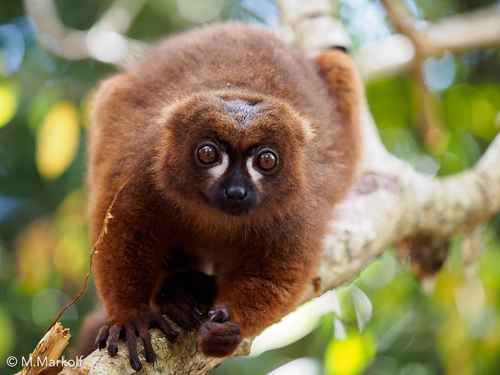
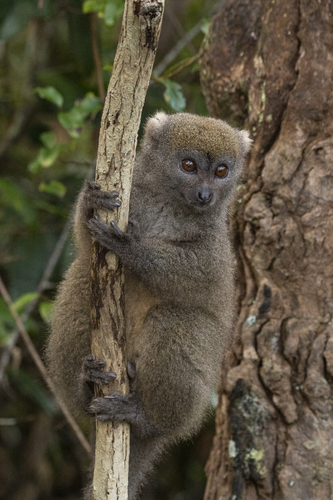
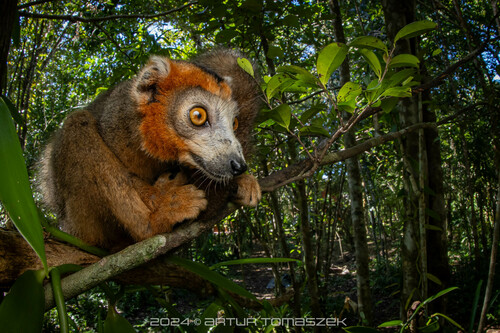
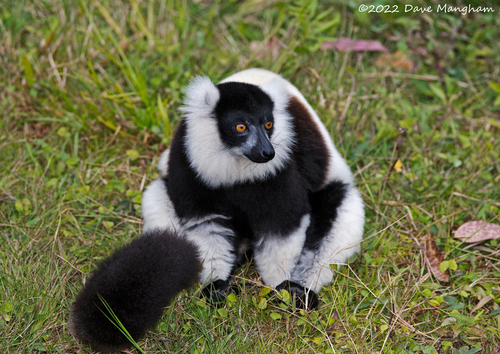
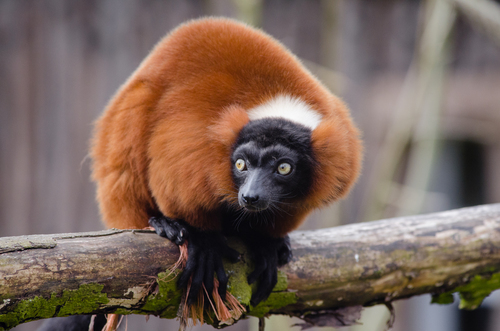
It has a gray coat, a black face, muzzle, and forehead, with a black line running from the muzzle to the forehead and white patches above its eyebrows.
Sexual Dimorphism
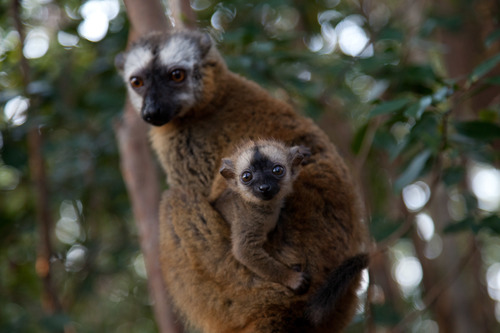
This species displays clear sexual dimorphism: males have white or cream colored cheeks and beards, while females have rufous or cream cheeks and beards that are less bushy than those of males.
Geographic Variation in Populations
This species shows considerable geographic variation in its natural history. Western populations tend to have smaller home ranges and higher population densities than eastern populations, though group size stays fairly consistent across populations, generally ranging from 4 to 18 animals with an average of 8 to 9 individuals.
Group Social Dynamics
No studied populations of this species have dominance hierarchies, and levels of aggression within groups tend to be low.
Diet Composition
The diet of the red-fronted lemur is diverse, including leaves, seeds, fruit, nectar, and flowers, and this diversity is more pronounced in eastern populations. Western populations rely more heavily on leaves as a food source.
Activity Patterns
Western populations are primarily diurnal, but increase their nocturnal activity during the dry season, while eastern populations do not show this strong seasonal shift in activity timing.
Reproduction and Mating Behavior
Reproduction in this species is seasonal. In western populations, one male usually monopolizes mating access to all females in the group, while this pattern of monopolization is less common in eastern populations.