About Varecia rubra (É.Geoffroy Saint-Hilaire, 1812)
Species Classification and Size Relative to Relatives
Red ruffed lemurs (Varecia rubra) are the larger of the two ruffed lemur species, and the largest members of the Lemuridae family.
Adult Size and Weight
Adults weigh 3.3–3.6 kg (7.3–7.9 lb), measure about 53 cm (21 in) in body length, and have a 60 cm (24 in) tail. Females are slightly larger than males.
Body Morphology
They have slender bodies, long legs, and a narrow snout, with small ears set back on the head that are sometimes hidden by their long fur. They groom themselves using a toothcomb.
Coloration and Markings
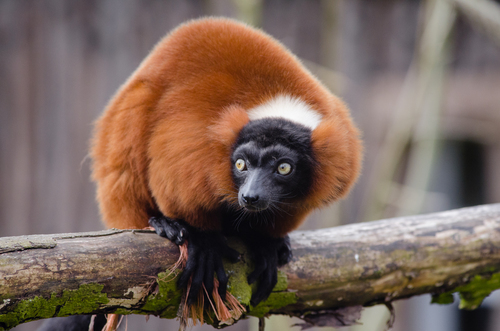
As their common name suggests, they have a rust-colored ruff and body; their heads, stomachs, tails, feet, and the inner surfaces of their legs are black. They have a white patch on the back of the neck, and may also have white markings on the feet or mouth.
Sexual Maturity Timing
Red ruffed lemurs reach sexual maturity at around two years of age, and begin reproducing at around three years.
Infant Nesting Behavior
Unlike all other diurnal primates, females keep their infants in nests built 10–20 m (33–66 ft) above the forest floor, constructed from twigs, leaves, vines, and fur.
Breeding Season Timing
Like all lemurs and many mammals native to Madagascar, this species has a fixed breeding season that falls toward the end of the dry season, between May and July. This timing means young are born in the wet season, when more food is available.
Litter Production Trait
Ruffed lemurs are the only primates that regularly produce litters of young.
Gestation and Litter Size
After a 102-day gestation period, a female may give birth to as many as six infants, though two or three is the more typical number.
Newborn Physical Capabilities
Newborn red ruffed lemurs are born with fur and are able to see, but they cannot move on their own. The female leaves her infants in the nest until they are seven weeks old.
Nursing Capacity
Females can nurse up to six infants at the same time.
Newborn Developmental Stage
Infant red ruffed lemurs are less well developed at birth than other lemur infants, which correlates with the species' extremely short gestation period; newborns are unable to hold onto their mother.
Infant Transport Behavior
When the mother needs to move her infants, she carries them one by one. Mothers usually move their infants away from the original nest after one or two weeks.
Foraging and Infant Placement
When she forages for food, she leaves her infants hidden in a nearby tree.
Paternal Guarding Behavior
In the first few days after giving birth, if the mother must leave the nest, the father will stand guard over the infants.
Weaning Age
Weaning takes place when infants are four months old.
Juvenile Mortality Rate
It is estimated that 65% of young do not survive to three months of age, most often dying from falls from trees.