About Eulemur albifrons (É.Geoffroy Saint-Hilaire, 1796)
Taxonomic Identification
The white-headed lemur, with the scientific name Eulemur albifrons, is a medium-sized lemur.
Body Posture
It has a horizontal body posture that is well-suited to its movement patterns.
Tail Function
Its long, furry tail helps it maintain balance when it lands after leaping considerable distances.
Sexual Dimorphism Overview
This species shows clear sexual dimorphism in coloration.
Male Coloration
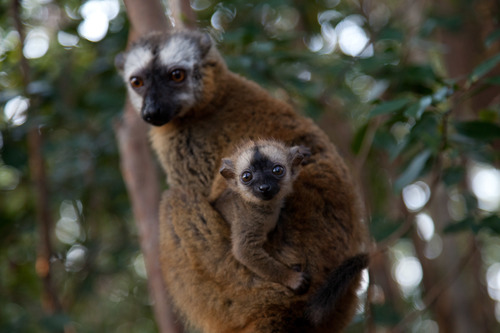
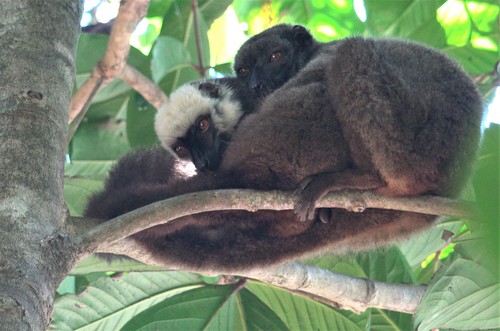
Males have gray-brown upper bodies, darker lower limbs and tail, paler gray on portions of the upper body, a gray head and face, and a darker crown.
Female Body Coloration
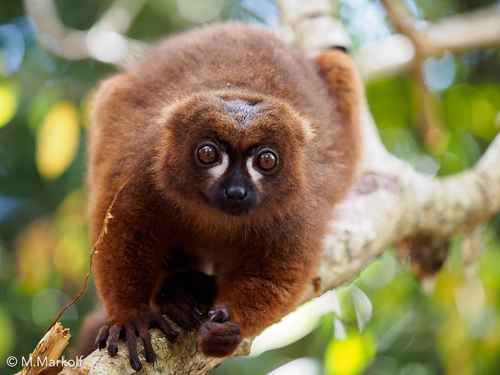
Females have redder-brown upper bodies, paler underparts, and darker feet than males.
Male Facial Hair
Males have prominent, bushy white cheeks and beards, while females have less bushy, reddish-brown cheeks and beards.
Female Facial Features
The head, face, and muzzle of females are dark gray, and females do not have the bushy cheeks that males have.
Size Measurements
The average body weight of the white-headed lemur is 2.3 kg (5.1 lb), average body length is 40 cm (16 in), and its tail can reach up to 50 cm (20 in) in length.
Lifespan
White-headed lemurs have a maximum lifespan of 30 years.
Previous Taxonomic Classification
This species was previously classified as Eulemur fulvus albifrons, a subspecies of the common brown lemur.
Species Status Justification
While it is very similar in appearance to the common brown lemur, genetic analysis supports its status as a distinct species.
Habitat Type
The white-headed lemur inhabits mostly moist lowland and montane rainforests.
Arboreal Behavior
It is arboreal and spends most of its time in the upper layers of the forest.
Geographic Range
It is endemic to north-eastern Madagascar, where it is found nowhere else.