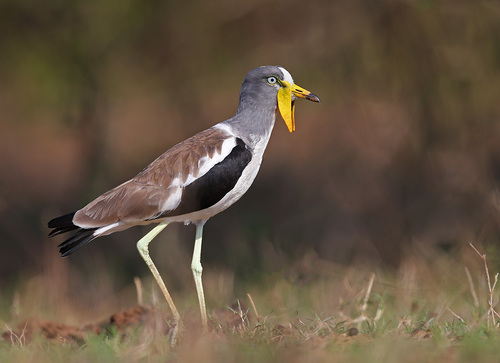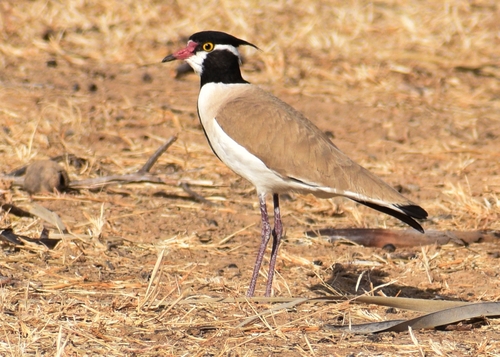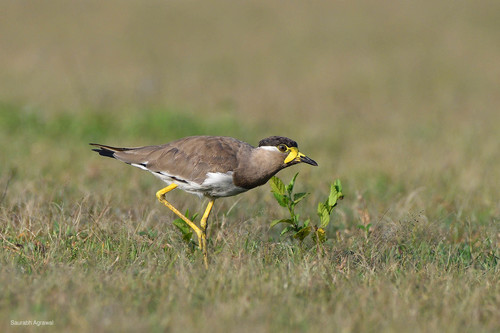
About Vanellus malabaricus (Boddaert, 1783)
Species Naming
This species is the yellow-wattled lapwing, with the scientific name Vanellus malabaricus (Boddaert, 1783).
General Morphology & Habitat
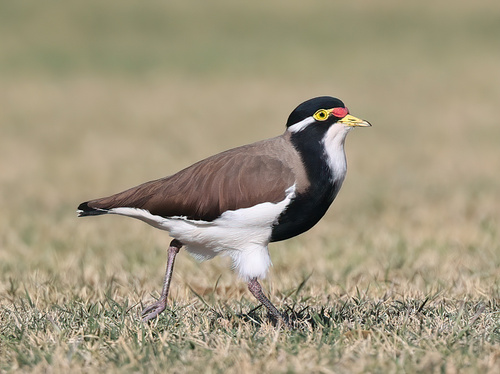
It is a conspicuous, easily identifiable medium-sized pale brown wader that inhabits dry stony ground, open grassland, and scrub habitats.
Key Identifying Features
Its key identifying features include: a black crown separated from the brown neck by a narrow white band, large yellow facial wattles, black chin and throat, a narrow blackish line dividing the brown neck and upper breast from the white belly, a subterminal black band on the tail that does not extend to the outer tail-feathers, a white wingbar on the inner half of the wing, a yellow-based bill, and tiny yellow carpal spurs.
Display Trait
The crown feathers can be raised slightly during displays.
Taxonomy & Size Clinal Variation
This species has no recognized subspecies, but individuals increase in size from south to north.
Adult Morphometrics
Adults measure 260-280mm in total length, with a 192-211mm wing, 23-26mm bill, 57-66mm tarsus, and 71-84mm tail.
Juvenile Plumage
Juveniles have a brown crown.
Sexual Dimorphism
The sexes look identical, though males have slightly longer wings and tarsi.
Vocalization
The call is a sharp tchee-it.
Local Names
Local names for this species include zirdi in Hindi, chitawa in Telugu, jithiri in Rajasthan and Pakistan, pili tatihri in Punjabi, laori in Madhya Pradesh, parasna titodi or vagdau titodi in Gujarati, pitmukhi titvi in Marathi, manjakanni in Malayalam, haladi tittibha in Kannada, aalkati in Tamil, and kiraluwa in Sinhalese.
Movement Patterns
Most individuals of this species are mostly sedentary, but populations will make long-distance movements in response to monsoons.
Vagrant Records
It is an occasional visitor to the Kathmandu valley in Nepal, and a vagrant individual has been observed in Malaysia.
Distribution Range
In terms of habitat and distribution, this species is common across much of India, found in a variety of open lowland habitats.
Habitat Niche Differentiation
It tends to occupy drier habitats than the related red-wattled lapwing, Vanellus indicus.
Geographical Distribution
It can be found across most of India, parts of Pakistan, Nepal, Bangladesh, and Sri Lanka.
Short-Distance Movement
It also makes short-distance movements in response to rain, though the exact pattern of these movements is not known.
Breeding Season
For behaviour and ecology: these lapwings breed in the dry season, with peak breeding occurring from March to May before the start of monsoons.
Nest Territory Size
Based on distance to nearest neighbouring nests, the average nest territory is about 2.7 acres.
Nesting & Clutch Size
They lay four eggs in a scrape dug in the ground; a nest located in a clump of grass has been recorded as an exceptional case.
Belly Soaking Behaviour
Parent birds will travel to water, soak their breast feathers (a behaviour called "belly soaking", where they may stay for up to 10 minutes to absorb water), and use the absorbed water to cool eggs or chicks.
Hatching Synchrony
Though eggs are laid a few days apart, all four typically hatch at the same time.
Chick Traits & Foraging
The nidifugous young are well camouflaged, and forage alongside their parents.
Anti-Predator Chick Behaviour
When parent birds give an alarm call, chicks squat flat on the ground and freeze to avoid detection.
Second Brood Observations
A pair may raise a second brood, especially if the first brood fails; young from an earlier brood have even been observed accompanying parent birds that are incubating a second clutch.
Courtship Displays
Simultaneous courtship displays among several pairs in close proximity have been recorded.
Clutch Size Variation
In one study, over 60% of nests had a 4-egg clutch, while the remaining nests had 3 eggs.
Hatching Success & Threats
Hatching success was found to be approximately 27.58%, with egg loss caused by predation and nest damage.
Incubation Period
The incubation period is 27–30 days.
Nest Defense Behaviour
When a nest is approached, the incubating bird will attempt to move away from the nest without drawing attention to the nest's location.
Diet
This lapwing feeds on beetles, termites, and other invertebrates, which it picks from the ground.
Ectoparasite Record
The feather mite Magimelia dolichosikya has been documented as an ectoparasite of this species.