About Vanellus chilensis (Molina, 1782)
Common Name and Taxonomic Baseline
Vanellus chilensis, commonly known as the southern lapwing, is the only crested wader native to South America.
Size Measurements
It measures 32 to 38 cm (13 to 15 in) in length and weighs approximately 250 to 425 g (8.8 to 15.0 oz).
Upperparts Coloration
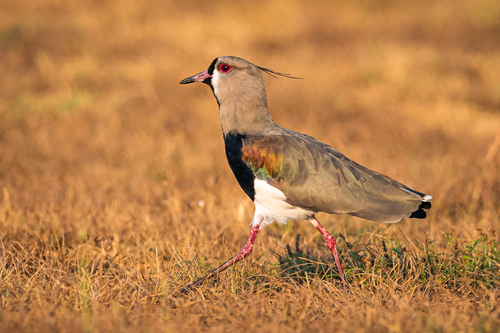
Its upperparts are mostly brownish grey, with bronze glossing on the shoulders.
Head and Breast Pattern
The head has a distinct striking pattern: it is primarily grey, with a black patch covering the forehead, throat, and extending to the black breast.
Facial Marking Border
A white border separates the black facial markings from the grey of the head and crest.
Underparts and Soft Part Coloration
The rest of the underparts are white, while the eye ring, legs, and most of the bill are pink.
Wing Spur Characteristics
This species has red bony wing spurs that it uses to intimidate enemies and fight birds of prey.
Flight Wing Pattern
During slow flapping flight, the southern lapwing displays a broad white wing bar that separates the grey-brown back and wing coverts from the black flight feathers.
Rump, Tail and Vocalization
It has a white rump and a black tail, and produces a very loud, harsh keek-keek-keek call.
Subspecies Recognition Basis
There are three or four recognized subspecies, which differ slightly in head coloration and voice.
Patagonian Subspecies Classification
Vanellus chilensis fretensis from Patagonia is sometimes grouped into the nominate subspecies V. c. chilensis.
Northern Subspecies Split Proposal
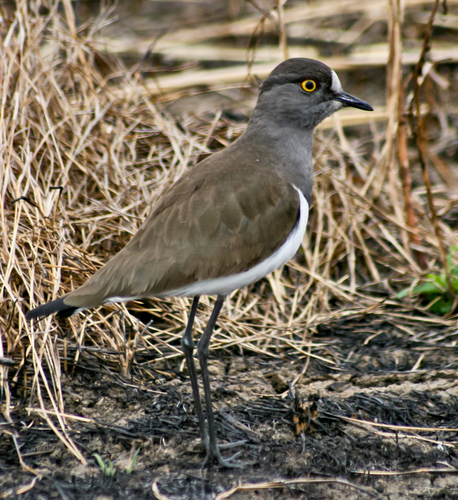
The two northern subspecies — V. c. cayennensis from the far north and V. c. lampronotus from south of the Amazon River — are sometimes classified as a separate distinct species, Vanellus cayennensis.
Northern Subspecies Morphological Traits
These two subspecies have browner heads, a trait most prominent in the northernmost populations, and their white face band, broad in V. c. cayennensis and narrow in V. c. lampronotus, does not extend to the center of the crown.
Subspecies Intergradation
Intergradation between forms has been observed in birds from the Uruguay region.
Habitat Preferences
Ecologically, the southern lapwing inhabits lake and river banks, as well as open grassland.
Habitat Expansion Benefit
It has benefited from the expansion of open grassland habitat caused by widespread cattle ranching.
Airport Nesting Hazard
When it nests near airports, it creates a hazard for aircraft safety.
Diet Composition
Its diet consists mainly of insects like grasshoppers, other small invertebrates including earthworms and cutworms, and small fish.
Foraging Behavior
It hunts using a run-and-wait technique, mostly at night, and often forages in flocks.
Urban Habitat Occurrence
In urban areas such as Rio de Janeiro, Montevideo, Buenos Aires, and La Plata, the species can even be seen feeding or walking in parks or on floodlit soccer pitches during televised matches.
Cooperative Breeding Group Structure
The southern lapwing breeds cooperatively in social groups, which are made up of a breeding pair plus one or two young from the previous breeding season.
Breeding Habitat and Courtship Display
It breeds on grassland and sometimes on ploughed fields, and performs an aerobatic flapping display flight during courtship.
Clutch and Nest Characteristics
It lays 2 to 3, rarely 4, olive-brown eggs in a scrape on bare ground.
Nest and Offspring Defense
Both the nest and young are defended loudly and aggressively against all intruders including humans, using threat displays, vocalizations, and low flights.
Post-breeding Dispersal
After the breeding season, the species disperses to wetlands and seasonally flooded tropical grassland.