About Vanellus tricolor (Vieillot, 1818)
Species Classification
The banded lapwing (scientific name Vanellus tricolor (Vieillot, 1818)) is a medium-sized shorebird.
Adult Size
Adults have short dark purplish legs, a dull red tibia, and measure 25 cm to 29 cm in length, with an average weight of 190 grams.
Juvenile Size
Juveniles are 22 cm to 25.5 cm long and weigh between 124 and 133 grams.
Locomotion on Land
This species has an upright stance and walks slowly, breaking into a faster trot when alarmed.
Bill and Wattle Features
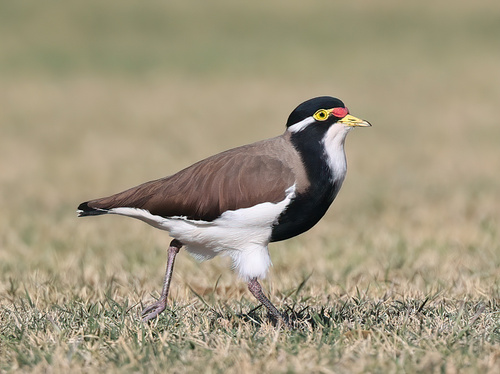
Its bill is pale yellow with a black tip, and a small red wattle sits at the base of the bill.
Sexual Dimorphism
The red wattle and wing spurs are more prominent in males than in females.
Adult Plumage and Markings
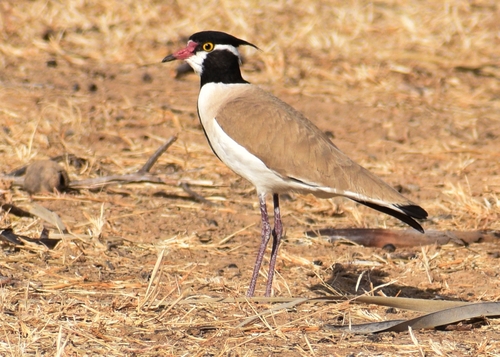
Key identifying features include a black cap, white throat and underparts, white eye stripes, a black breast band that extends up each side of the neck to the face, and bright yellow irises.
Flight Traits
Banded lapwings fly with quick, clipped wing beats, which gives them the common name 'lapwing'.
Juvenile Plumage
Juvenile plumage is similar to adult plumage, but the crown, nape, sides of the neck, and breast are mottled dark brown, and upper part feathers are tan.
Endemic Range
Banded lapwings are endemic to Australia, found across the Australian mainland and Tasmania.
Distribution Limitations
They are rarely found in northern Australia, and uncommon in most coastal areas.
Water Dependency
They are not dependent on wetlands, and may live far from water.
Preferred Habitat
They prefer open plains and short grassland habitats such as heavily grazed paddocks, agricultural lands, and recently germinated cereal crops, which are most commonly found inland as well as in coastal and inland pastures.
Avoided Habitat
They avoid Acacia scrub areas, except where overgrazing has made the scrub more open.
Anthropogenic Habitat Benefit
The species has probably benefited from the clearing of forests and woodlands for agriculture in southern Australia.
Non-breeding Social Behavior
Outside of the breeding season, banded lapwings gather in small flocks and are nomadic.
Movement Drivers
Their movements between areas are influenced by seasonal conditions.
Victorian Occurrence Pattern
Records from the Atlas of Victorian Birds note that banded lapwings are most frequently reported in Victoria during spring and winter, suggesting that they breed in Victoria when rainfall is highest.