About Vanellus crassirostris (Hartlaub, 1855)
Taxonomy and Size
The long-toed lapwing, with scientific name Vanellus crassirostris (Hartlaub, 1855), measures 31 cm (12 in) in length and has a body mass of 162–225 g (5.7–7.9 oz).
Adult Plumage and Morphology
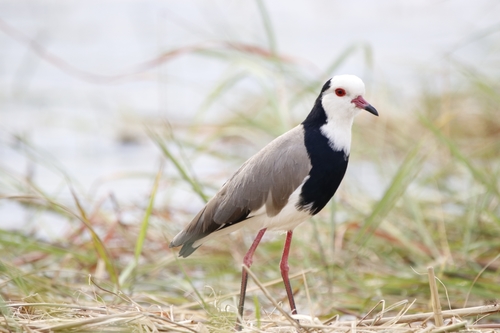
It is a lapwing colored brown, black, and white, with long red legs, long toes, and a red bill that has a black tip. It has short wing spurs and rounded wings; when in flight, it shows extensive white on the wing feathers, and its legs and feet extend past the end of the tail.
Plumage Variation
It is sexually monomorphic and has no seasonal plumage variation. Juveniles have a browner breast than adults, with buff-colored feather tips.
Juvenile Moult
Juvenile primary feathers are retained after the post-juvenile moult.
Species Distribution
The long-toed lapwing is found across central and eastern Africa, ranging from South Sudan in the north to Botswana, Mozambique, and northeast South Africa in the southern end of its range, with additional outlying populations in Chad and western Angola.
Preferred Core Habitat
This species prefers habitats of lakes, pools, marshes, floodplains, and swamps. It feeds on aquatic invertebrates found on floating vegetation.
Seasonal Habitat Use
In the dry season, it uses pool edges, while in the wet season it is often found in flooded rice fields and wet grasslands. These birds remain sedentary as long as water stays available, and their nesting and foraging areas are generally the same.
Elevation Range
It has been recorded at elevations up to 1,300 m (4,300 ft) in Zambia.
Co-occurrence with African Jacana
The long-toed lapwing shares similar habitat preferences with the African Jacana, and both use floating weeds and fringing vegetation around water. This close association often leads lapwings to behave aggressively toward jacanas, which mostly takes the form of swooping attacks that do not make direct contact; one study found adult lapwings attacked jacanas once every 12 minutes.
Breeding Territories
Long-toed lapwings are monogamous breeders that aggressively defend small breeding territories, with a mean territory area of 2,900 m2 (0.29 ha) in Kenya, against neighboring lapwings. Both sexes participate in egg incubation, territory defense, and parental care for young.
Predator Defense
Parents fiercely defend chicks from avian predators including African fish-eagles, harriers, and coucals. They use persistent alarm calls and swooping attacks as strong anti-predator responses, along with escape flights where they fly and hover over water.
Predator Recognition
Long-toed lapwings respond to predators such as harriers, but can recognize other non-predatory raptors like vultures and do not react to them.
Nest Location and Structure
The nest can be constructed from plant material or mud, located on the ground near a water edge or on floating vegetation. When built near the water's edge, the nest is a shallow scrape made of mud or plants.
Floating Vegetation Nests
On floating vegetation above water up to 1 meter deep, the nest is cup-shaped and made from plants. Long-toed lapwings in swampy areas are also known to build nests using a platform of mosses and weeds.
Egg Laying and Incubation
Females lay 1 to 4 brown or olive-colored eggs with dark markings, and incubate the eggs for 27 to 30 days.
Chick Development
Chicks are precocial, leaving the nest only a few hours after hatching, and fledge approximately two months after hatching. Young birds regularly stay with their parents for an additional 1 to 2 months after fledging.
Breeding Season Trade-offs
Parental behaviors like vigilance and tending young reduce the foraging time of adult birds during the breeding season.
Breeding Timing
Breeding occurs year-round across the entire range of the long-toed lapwing. In central Africa, egg laying takes place from December to March, while in eastern Africa stretching from Uganda to northeast South Africa, egg laying occurs from June to November.