About Charadrius asiaticus Pallas, 1773
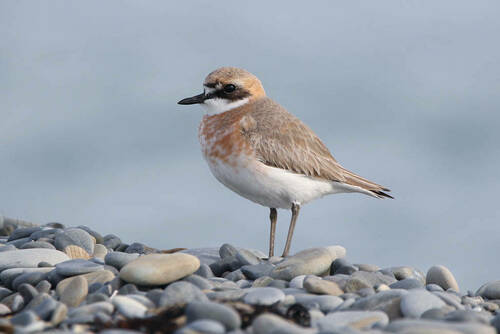
This species of plover is slightly larger than the ringed plover, and resembles the greater sandplover and lesser sandplover in overall appearance.
Size and Build
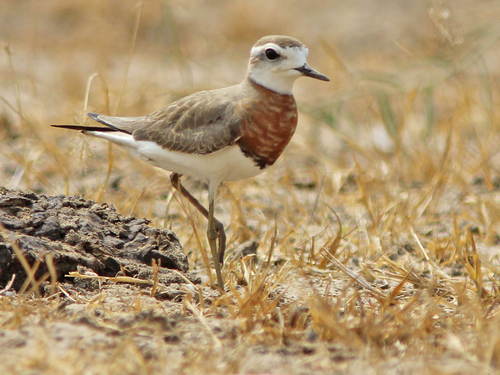
Compared to sandplovers, it has a slimmer build, longer legs, a much more prominent white supercilium, and a long, thin bill.
Plumage Field Marks
It does not have white tail sides, and its wing bar is weak.
Breeding Male Plumage
In breeding plumage, males have grey-brown backs, white faces and white bellies. Their breast is chestnut-colored, with a black border along the lower edge.
Non-breeding and Female Plumage
In non-breeding plumages, the breast has a grey-brown band, though breeding females may show a faint hint of chestnut on the breast.
Vocalization
Its call is a sharp chip.
Breeding Range
The Caspian plover breeds in western Asia, around the Caspian Sea, with its breeding range covering southern Russia, Turkey, Iran, Turkmenistan, Kazakhstan, Uzbekistan and Afghanistan.
Breeding Habitat
During the breeding season, it inhabits steppes, desert verges, saltpans, and areas of saline soil with sparse shrubby vegetation, occurring up to an altitude of approximately 800 m (2,625 ft).
Winter Range
After breeding is complete, it migrates to eastern and southern Africa, reaching as far south as the Zambezi River.
Winter Habitat
In its winter range, it typically occupies dry grassland, coastal dunes, saltmarshes, dry floodplains, and sometimes cultivated land.
Vagrant Occurrences
It is a very rare vagrant to western Europe, and is also a rare vagrant to Australia.