About Vanellus coronatus (Boddaert, 1783)
Identification Features
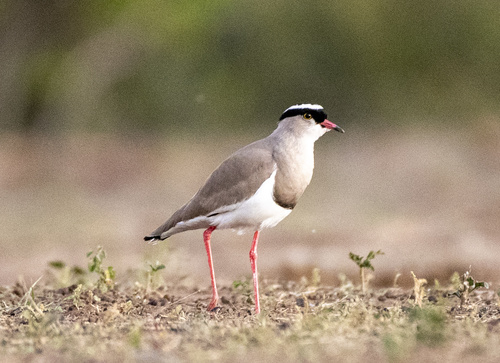
The crowned lapwing (Vanellus coronatus) is easily identifiable by its mix of brown and white plumage, most notably a black crown crossed by a ring-shaped white halo. Adult crowned lapwings are noisy and easy to spot.
Sexual Size Dimorphism
On average, males are 3% larger than females.
Juvenile Morphology
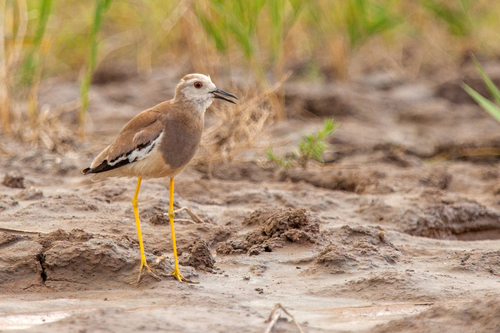
Juveniles are duller versions of adults, with vermiculated patterns on their wings and mantle, yellowish legs instead of the adults' red legs, and a bill that lacks the adults' red base.
Habitat Preference
Crowned lapwings prefer short, dry grassland that may be overgrazed or burnt, and avoid mountain areas.
Regional Occurrence Patterns
In regions with higher rainfall, such as parts of Zambia and Zimbabwe, they are mainly present as dry-season visitors. In dry regions of northern Botswana, large numbers of crowned lapwings are attracted when good rainfall occurs.
Southern Africa Concentration
Their highest concentrations in southern Africa are found in the dry central Kalahari region.
Abundance Within Range
Although blacksmith lapwings generally outnumber them, crowned lapwings are the most widespread and locally the most numerous lapwing species within their distribution range.
Population Trend
Their population increased during the latter half of the 20th century, as they benefited from a variety of human activities.
Lifespan
They can live up to 20 years.
Conservation Agreement
The crowned lapwing is one of the species covered by the Agreement on the Conservation of African-Eurasian Migratory Waterbirds (AEWA).
Diet Composition
The diet of the crowned lapwing is made up of a variety of insects, with termites and ants forming an important part of their food.
Foraging Location
These insects are often collected from the dung of large mammals.
Feeding Behavior
They feed mainly by pecking at the surface rather than digging.