About Thinornis cucullatus (Vieillot, 1818)
Species Overview
The hooded plover (Thinornis cucullatus) is a stocky, pale-colored plover of medium size for its group.
Size Measurements
It measures 190 to 230 mm (7.5–9.1 in) in length, with a wingspan of 230 to 440 mm (9.1–17.3 in).
Adult Plumage and Features
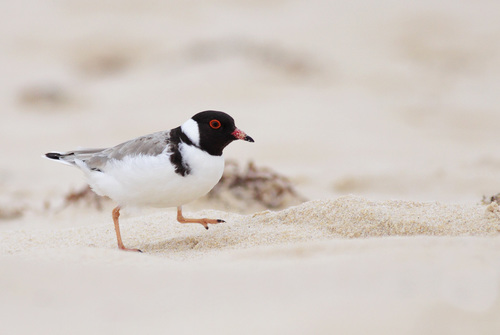
This species has a black hood and throat marked by a white collar, a red bill with a black tip, a red eye ring, and orange legs. Its underparts are white.
Sexual and Age-related Appearance
Males and females have similar appearance. Adults and juveniles are also similar, except juvenile hooded plovers lack the black head and hindneck that adults have; these regions are sandy brown in juveniles.
Natural Habitats
The natural habitats of the hooded plover are freshwater lakes, freshwater marshes, coastal saline lagoons, and sandy beaches.
Population Density Drivers
Dense populations occur on beaches with seaweed and dunes.
Threat Status
This species is threatened by habitat loss due to its small population size and limited native range.
Distribution and Movement
It is a non-migratory bird that lives in coastal and subcoastal areas of Western Australia, South Australia, New South Wales, Victoria and Tasmania, and it occurs as a vagrant in Queensland.
Diet Knowledge Gaps
The eastern population of the hooded plover eats a variety of invertebrates, but little information is available about the diet of the western population.
Confirmed Prey Items
Confirmed prey items include insects, bivalves, and sandhoppers.
Social Behavior
Hooded plovers are usually seen in pairs or small groups near water.
Nesting Habits
To breed, they dig a shallow scrape in sand or gravel above the high-water mark, and line the scrape with pebbles, seaweed, and other debris.
Incubation Patterns
Both males and females spend equal amounts of time incubating eggs overall, though males typically incubate more often at night.