About Charadrius alexandrinus Linnaeus, 1758
Scientific Naming & Classification
The Kentish plover, scientifically named Charadrius alexandrinus Linnaeus, 1758, is a small shorebird.
Adult Weight
Adult Kentish plovers weigh around 40 grams.
Basic Adult Morphology
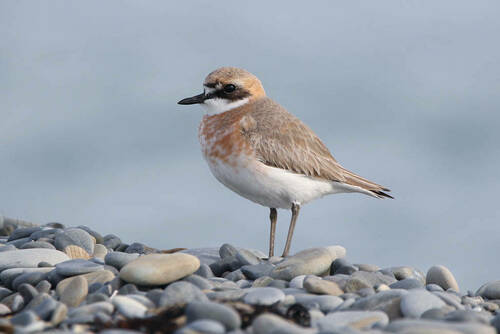
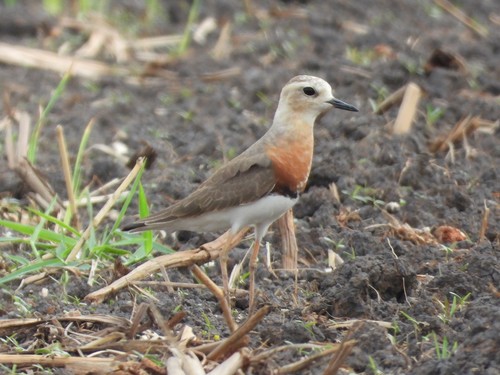
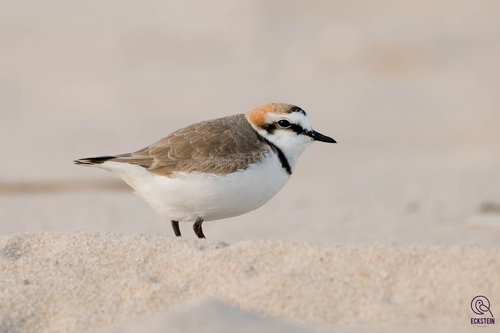
Both adult males and females have black bills and dark legs, but they have plumage dimorphism.
Breeding Male Plumage
During breeding season, males have a black horizontal head bar, two incomplete dark breast-bands on each side of the breast, black ear coverts, and a rufous nape and crown, with some variation across different breeding populations.
Breeding Female Plumage
Females are paler in these areas and lack the dark markings.
Early Breeding Season Sexual Dimorphism
Early in the breeding season, male and female ornaments are very pronounced, making them easy to tell apart.
Late Breeding Season Sexual Dimorphism
As the breeding season goes on, the differences between the two sexes become less noticeable.
Non-plumage Sexual Morphology
Additionally, males have longer tarsi and longer flank feathers than females; longer flank feathers are thought to be beneficial for incubation and brood care, since feather quality is linked to heat insulation.
Plumage Ornamentation Predictors
There are several significant factors that predict the degree of plumage ornamentation in Kentish plovers.
Rainfall & Breeding Season Ornamentation Effects
First, the interaction between breeding season progression and rainfall appears to affect ornamentation: male ornaments grow more elaborate over the course of a breeding season in high-rainfall regions, while they become lighter in low-rainfall regions.
Breeding System & Ornamentation Relationship
Second, the interaction between breeding system and sex can predict how pronounced plumage ornamentation is.
Polygamous vs Monogamous Population Dimorphism
Polygamous populations have more pronounced sexual ornaments, leading to stronger sexual dimorphism than monogamous populations.
Male Ornament Variation By Breeding System
This difference is especially clear in males: males in polygamous populations have darker and smaller ornaments, while males in monogamous populations have lighter and larger ornaments.
Ornament Trade-off Hypothesis
This is thought to result from a trade-off between the size and intensity of the ornaments.
General Distribution & Habitat Range
Kentish plovers have an extremely wide geographical distribution, and their habitats vary both spatially and environmentally.
Habitat Types
They live and breed in multiple habitat types, ranging from deserts with ground temperatures up to 50 °C to tundra.
Continental Breeding Distribution Overview
Their breeding distribution covers Europe, Asia, and Africa.
European Breeding Distribution
In Europe, populations are typically found in the west; there was once a breeding population in Hungary, but Kentish plovers no longer breed there.
African Breeding Distribution
In Africa, populations live on the southern coast of Senegal, along the northern Mediterranean coast, and along the Red Sea coast.
Middle Eastern Breeding Distribution
The breeding area continues along the Arabian Peninsula, covering Saudi Arabia, Qatar, and Bahrain in the Middle East.
Island Breeding Populations
Small populations also live on islands, including the Cape Verde archipelago, the Canary Islands, and the Azores.
Vagrant Status In Australia
It is a rare vagrant in Australia.
Migratory Strategy Variation
Some Kentish plover populations are non-migratory, such as the population on Maio in Cape Verde, while other populations migrate fairly long distances.
North African Wintering Population Migration
For example, plovers that winter in North Africa are known to migrate to Turkey and Greece in spring.
Western European Breeding Population Migration
Some birds breeding in western Europe do not travel far, only staying within Europe, while others travel mainly to Western Africa.