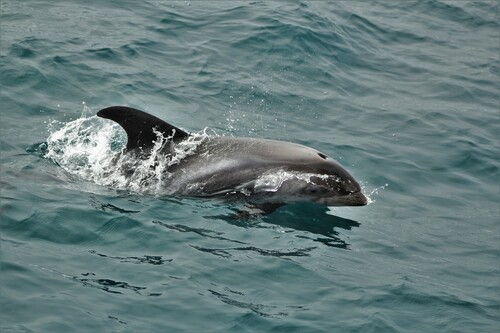
About Globicephala macrorhynchus Gray, 1846
Base Coloration
Globicephala macrorhynchus, commonly known as the short-finned pilot whale, has a base coloration ranging from black to dark gray or brown.
General Morphology
It has a thick tail stock, a fluke with sharply pointed tips, a bulbous head, and a broad, sickle-shaped dorsal fin.
Distinctive Markings
Typical coloration includes light gray to white markings: a saddle patch behind the dorsal fin, a light gray or white anchor-shaped patch under the chin and belly, and a blaze marking behind the eye.
Population Morphological Variation
These physical traits can vary between populations. For example, two distinct forms are recorded off the Pacific coast of central Japan.
Shiho Morphotype Traits
The larger Shiho morphotype has females measuring 4 to 5 m (13 to 16 ft) and males measuring 5 to 6 m (16 to 20 ft), with a white dorsal patch and a round melon (the bulbous forehead structure).
Naisa Morphotype Traits
The smaller Naisa type has females measuring 3 to 4 m (10 to 13 ft) and males measuring 4 to 5 m (13 to 16 ft), with a characteristic flattened or squarish melon and a darker, indistinct saddle patch.
Maximum Species Size
The maximum recorded size for the species is 7.2 m (24 ft) in length and up to 4,000 kg (8,800 lb) in weight, making it the third-largest species of oceanic dolphin, ranking behind only the orca and the long-finned pilot whale.
Newborn Size
Newborn short-finned pilot whales measure 1.4 to 1.9 m (4 ft 7 in to 6 ft 3 in) in length and weigh around 60 kg (130 lb).
Long-finned Pilot Whale Distinction Difficulty
Short-finned pilot whales are often difficult to distinguish from long-finned pilot whales.
Flipper Length Difference
As their common name suggests, the flippers of short-finned pilot whales are shorter than those of long-finned pilot whales, measuring around one-sixth of the animal's total body length.
Dental and Rostral Differences
Short-finned pilot whales also have fewer teeth, with 7 to 9 teeth in each row, and a shorter, broader rostrum (snout) where the premaxilla bone covers more of the maxilla bone.
Shared Traits and Size Comparison
Both species exhibit sexual dimorphism and have similar lifespans: around 45 years for males and 60 years for females, and long-finned pilot whales are generally larger overall than short-finned pilot whales.
Global Geographic Overlap
The two species have limited geographic overlap across the world: long-finned pilot whales live in cooler temperate waters, while short-finned pilot whales are distributed mostly in tropical and subtropical regions.
Broad Species Distribution
Short-finned pilot whales occur in both coastal and pelagic waters across temperate and tropical regions of the Indian, Atlantic, and Pacific Oceans.
Northwest Atlantic Range
Information on spatial habitat use by short-finned pilot whales in the northwest Atlantic is limited, but the species is thought to range from the southern end of Georges Bank into the tropics, overlapping with the range of long-finned pilot whales along the mid-Atlantic shelf break between Delaware and Georges Bank.
Japanese Morphotype Distribution
Off the coast of Japan, the distributions of the Shiho and Naisa types are well-documented and largely nonoverlapping: Naisa-type individuals inhabit the warm-temperate waters of the Kuroshio Current, while Shiho-type individuals inhabit the cold-temperate waters of the Oyashio Current.
Morphotype Subspecies Evidence
Some evidence suggests these two populations may even be separate subspecies, based on differences in morphology, mitochondrial DNA, and breeding seasons.
Global Morphotype Range
Outside of Japan, the Naisa-type is found in southeast Asia, the Indian Ocean, and Hawaii, while the Shiho-type can be found in the California Current and off Peru.
Natal Philopatry
Pilot whales display strong natal philopatry.
Residency and Migration Patterns
Many populations remain year-round in locations including Hawaii, the U.S. and British Virgin Islands, the Madeira Islands, and parts of California, though some populations migrate to follow seasonal and annual fluctuations in water temperature and productivity.
Southern California Population Decline
Short-finned pilot whales were once commonly sighted off Southern California, but disappeared from the area after the strong El Niño events of 1982 and 1983.
Post-1980s Southern California Sightings
Since that time, they have only been encountered infrequently, mostly during warm-water years including 1991, 1993, 1997, 2014, and 2015.
Southern California Stock Status Uncertainty
It remains unknown whether the individuals sighted more recently belong to the same population documented off Southern California before the mid-1980s, or belong to a different wide-ranging pelagic population, so the conservation status of this stock is still unknown.
Whale-watching Economic Importance
Short-finned pilot whales are economically important to the whale-watching industry in several parts of the world, including Madeira, Hawaii, and the Canary Islands, all of which host resident populations of the species.
Tourism Impact Risks
The effects of tourism activities on these whales have not been extensively studied, but some evidence indicates that underwater noise from whale-watching boats can significantly disrupt communication when boats are at close range.
Whale-watching Guidelines
Many countries have published safe whale-watching guidelines designed to minimize the impact of human activities on the whales.
Mating System
In terms of reproduction, male short-finned pilot whales are polygynous, meaning they mate with multiple females at one time and throughout their lives.
Pod Adult Sex Ratio
Pods typically contain around one mature male for every eight mature females.
Mating Dispersal Behavior
During mating aggregations, males temporarily leave their pods to mate with females from other pods, then return to their original pods after mating is complete. This behavior helps prevent inbreeding.
Female Reproductive Maturity and Calving Rate
Females reach sexual maturity at around 7 to 12 years of age, and produce a new calf every five to eight years, averaging 4 to 5 calves over their entire lifetime.
Suckling and Lactation Period
Calves suckle from their mothers for a minimum of two years, with most continuing to suckle for five years, and some evidence indicates that females may continue lactating for up to 15 years after the birth of their last calf.
Reproductive Senescence
Females usually stop reproducing once they reach 40 years of age, even though their maximum lifespan is over 60 years.