About Lagenodelphis hosei Fraser, 1956
Size at Birth and Adulthood
Fraser's dolphin (Lagenodelphis hosei Fraser, 1956) measures around 1 m (3 ft 3 in) long and weighs 20 kg (44 lb) at birth, growing to 2.75 m (9 ft 0 in) long and 200 kg (440 lb) when fully adult.
Body and Fin Structure
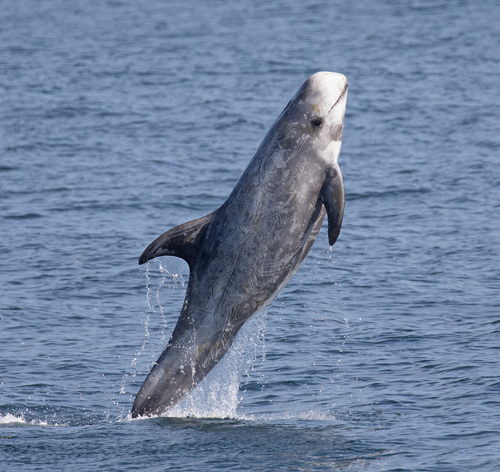
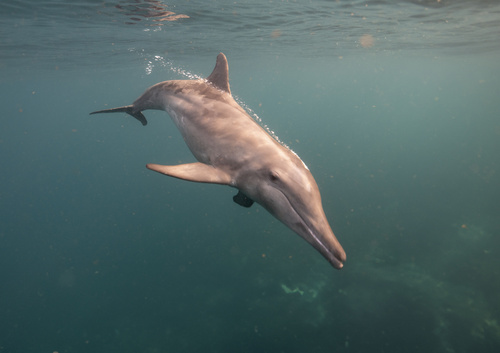
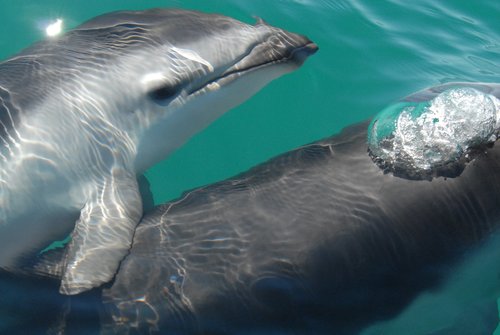
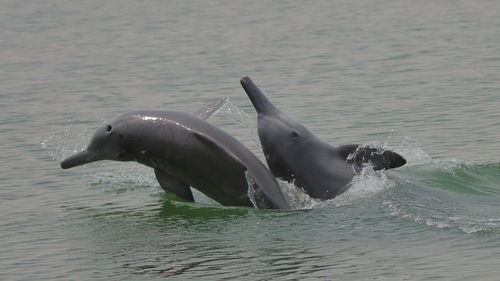
This species has a stocky build, with a small dorsal fin relative to its body size, conspicuously small flippers, and a shorter dorsal fin and beak than other dolphin species.
Dorsal Coloration
Their upper side ranges from gray-blue to gray-brown.
Flank Markings
A muted cream-colored line runs along their flanks, starting at the beak, passing above the eye, and ending at the anus. There is a dark stripe running underneath this cream-colored line.
Ventral Coloration
The belly and throat are usually white, and sometimes show a pink tint.
Distinguishing Features and Similar Species
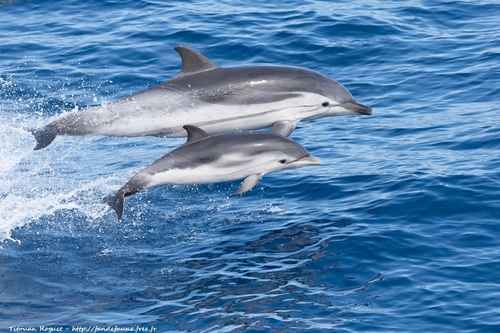
The absence of a prominent beak is a distinguishing feature of this dolphin, though from a distance it can be mistaken for the striped dolphin, which shares similar coloration and lives in the same regions.
Group Swimming Behavior
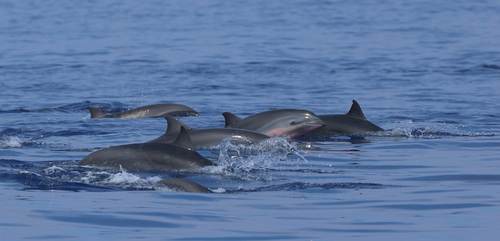
Fraser's dolphins swim quickly in large, tightly packed groups that can number between 100 and 1,000 individuals. Groups often porpoise, and create a great deal of visible disturbance on the water surface. A large group of Fraser's dolphins fleeing from a fishing vessel has been described as a very dramatic sight.
Genitalia Trait
This species is unique among open sea dolphins for having the smallest genitalia.
Diet Composition and Prey Depth
Fraser's dolphins feed on pelagic fish, squid, and shrimp that live between 200 m (660 ft) and 500 m (1,600 ft) below the water surface.
Hunting Method
Almost no sunlight reaches this depth, so the species hunts exclusively using echolocation.
Research and Population Estimate Status
Although the species was only documented relatively recently, the number of confirmed sightings has grown substantially, indicating it may not be as rare as it was thought to be as recently as the 1980s. It remains far less studied than more coastal dolphin species, and no global population estimate for the species is available.
General Geographic Range
Fraser's dolphins are typically found in deep tropical waters between 30°S and 20°N. Sightings are most consistently reported in the Eastern Pacific.
Anomalous Strandings
Stranded groups have been found as far from the species' normal range as France and Uruguay, but these occurrences are considered anomalous, likely caused by unusual oceanographic conditions such as El Niño.
Atlantic Ocean Distribution
The species is relatively common in the Gulf of Mexico, but less common in other parts of the Atlantic Ocean.
Philippines Population
The Philippines is a well-known location for Fraser's dolphin sightings, and hosts one of the largest populations of the species in the world.