About Lagenorhynchus obliquidens Gill, 1865
Common Name and Body Color Pattern
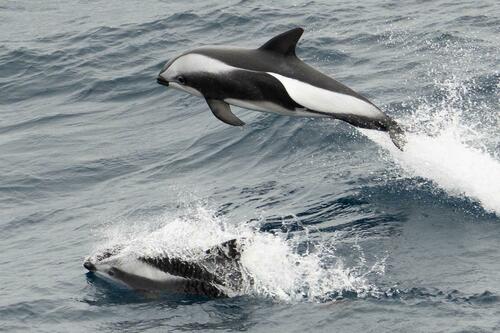
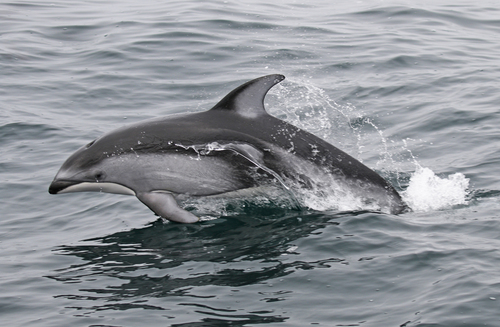
This species, commonly known as the Pacific white-sided dolphin, has a three-colored body. Its chin, throat, and belly are creamy white, while its beak, flippers, back, and dorsal fin are dark gray.
Additional Markings
Light gray patches appear on its sides, and an additional light gray stripe runs from above the eye to below the dorsal fin, thickening along the tail stock. A dark gray ring surrounds each eye.
Body Size
The Pacific white-sided dolphin is an average-sized oceanic dolphin. Females grow up to 2.3 m (7.5 ft) in length and weigh up to 150 kg (330 lb), while males reach up to 2.5 m (8.2 ft) in length and weigh up to 200 kg (440 lb). They are typically larger than dusky dolphins.
Female Sexual Maturity
Females reach sexual maturity at seven years of age. A 1990-1991 study led by Richard C. Ferrero and William A. Walker found that the vast majority of Pacific white-sided dolphins killed by drift nets were between 8.3 and 11 years old at sexual maturity.
Life History Traits
Their gestation period usually lasts one year, and individuals are thought to live up to 40 years or more.
Behavior and Social Associations
Pacific white-sided dolphins are extremely active, and often associate with many other North Pacific cetacean species. They readily approach boats to bow-ride.
Group Size
Large groups are common, with an average group size of 90 individuals, and supergroups containing more than 300 individuals.
Diet
Their main prey items are hake, anchovies, squid, herring, salmon, and cod.
Tooth Count
They have an average of 60 teeth.
Geographical Range
The Pacific white-sided dolphin's range spans the cool to temperate waters of the North Pacific. On the western side of the North Pacific, sightings do not occur further south than the South China Sea, and on the eastern side, sightings do not go further south than the Baja California Peninsula. Populations can also be found in the Sea of Japan and the Sea of Okhotsk, and some individuals may occur in the Bering Sea in the northern part of the species' range.
Migratory Pattern
Pacific white-sided dolphins follow a migratory pattern: on the eastern side of their range, they are most abundant in the Southern California Bight in winter, and further north off Oregon and Washington in summer.
Habitat Preference
They prefer offshore deep waters year-round.
Predators
The only known regular predator of the Pacific white-sided dolphin is the killer whale, though at least one case of predation by the great white shark has been recorded.
Population Estimate
The total global population may be as high as 1 million.
Population Sampling Challenges
The species' tendency to approach boats complicates precise population sampling and estimates.