About Trogon ramonianus Deville & Des Murs, 1849
Trogon Sexual Dimorphism
All trogons have distinctively different male and female plumage, with soft, often colorful feathers.
Species Identification and Size
The Amazonian trogon (Trogon ramonianus Deville & Des Murs, 1849) is about 23 to 25 cm (9.1 to 9.8 in) long; three measured males weighed 44 to 46 g (1.6 to 1.6 oz).
Male Head and Breast Plumage
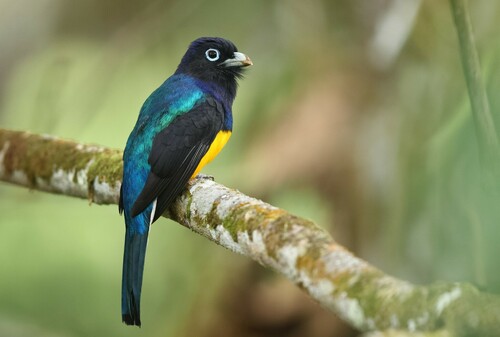
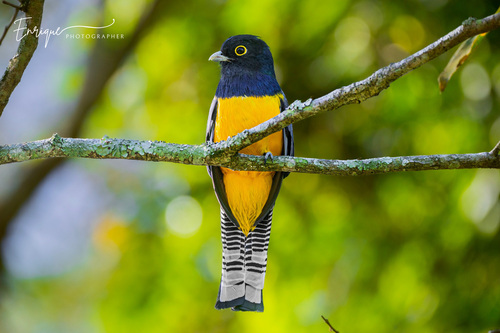
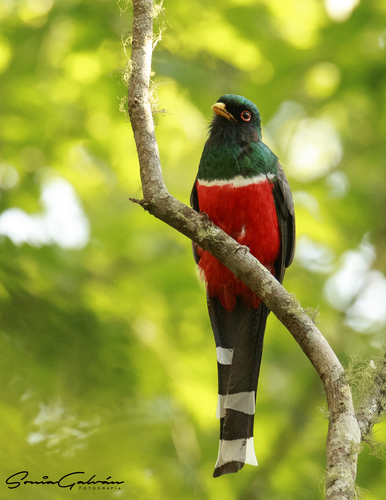
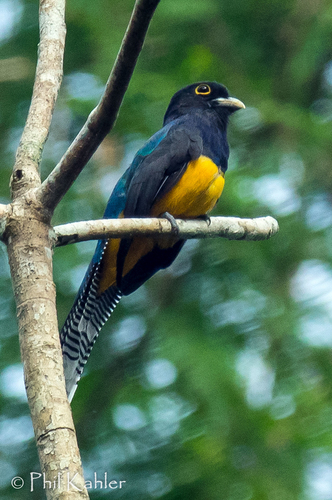
For males, the head, neck, and upper breast are deep metallic blue-black. The face and throat are black, with very little contrast between these areas and the rest of the head. A narrow white band separates the upper breast from the bright yellow lower breast and belly.
Male Upperparts and Tail Plumage
The upperparts range from metallic green to blue-green. The upperside of the tail is deep blue with black feather tips; the underside has fine black and white bars and broad white feather tips.
Male Wing Plumage
The wings are mostly black with some whitish markings.
Female Plumage
For females, the head and face, upper breast, and upperparts are dark gray; the belly is a duller yellow than the male's, and the underside of the tail has a different black and white pattern.
Subspecies Plumage Variation
The plumage of the two recognized subspecies differs very little, and the differences between the two subspecies are similar in scale to individual variation within each subspecies.
Species Geographic Range
The Amazonian trogon ranges from the Andean foothills of Colombia, Ecuador, Peru, and Bolivia slightly north into western Venezuela, and extends east across the western and southern Amazon basin of Brazil.
Subspecies Range Boundary
The exact boundary between the ranges of the two subspecies is unclear, but T. r. crissalis is generally accepted to occur south of the Amazon River and east of the Tapajós River.
Habitat Types
This species inhabits a variety of forest landscapes, including transitional forest, terra firme forest, palm forest, bamboo forest, and permanently flooded igapó forest.
Elevation Range
It occurs mostly below 500 m (1,600 ft) in elevation, but can be found as high as 1,000 m (3,300 ft) in Ecuador.