About Harpactes duvaucelii (Temminck, 1824)
Taxonomy and Species Status
The scarlet-rumped trogon (scientific name Harpactes duvaucelii (Temminck, 1824)) is the smallest trogon species in the world.
Adult Size Measurements
Adult individuals measure around 23–24 cm (9.1–9.4 in) in total length, with wings 10 to 11 cm (3.9 to 4.3 in) long, tails about 11 to 13.5 cm (4.3 to 5.3 in) long, and body mass between 34 and 43 g (1.2 and 1.5 oz).
Egg Measurements
Its eggs are estimated to measure 23.7 mm × 19.9 mm (0.93 in × 0.78 in) and weigh 5.2 g (0.18 oz).
Male Plumage (Head and Neck)
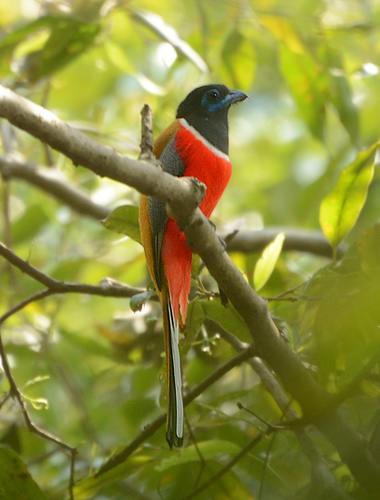
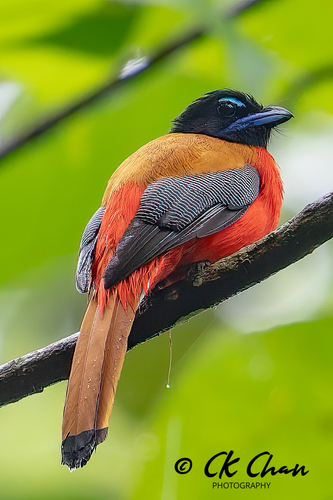
Males have a black head, neck, and throat, while females and juveniles have duller brown coloration.
Male Plumage (Body)
Males have red underparts, rump, and uppertail coverts, paired with rich buff or yellowish-brown upperparts and uppertail.
Female Plumage
Females have a buffy-brown breast, reddish-pink belly, and pink rump and uppertail-coverts.
Juvenile Plumage
Juveniles share similar coloration to females, but lack pink and are more rufous in tone.
Shared Physical Features
Both sexes have a blue bill, blue eyebrow, and thin blue eye ring, with pinkish, blueish, or rarely grayish black feet and toes.
Tail and Wing Patterns
The underside of their tail is white with black borders, and their wings have a black and white vermiculated pattern; immature males sometimes have black and cinnamon vermiculation instead.
Species Distinguishing Traits
When compared to other trogon species, the scarlet-rumped trogon can be distinguished by its small size and reddish rump.
Geographic Range
This species is a resident native to lowland forests across southern Thailand, southern Myanmar, the Malay Peninsula, Sumatra, the Riau Archipelago, and the islands of Banjak, Bangka, Belitung, Borneo, and Natuna.
Primary Habitat
It occupies the middle storeys of lowland semi-evergreen, evergreen, and freshwater swamp forests in both lowlands and hilly areas.
Secondary Habitat Range
It may also be found in lower forest storeys, forest edges, and mature secondary growth, but generally does not occur in mangroves, cultivated areas, or open country.
Habitat Preference
This species favors habitats that support lianas.
Elevation Range by Location
The highest elevation at which individuals have been sighted varies by location: 1,070 m (3,510 ft) on the Malay Peninsula, 1,500 m (4,900 ft) on Mount Kinabalu, around 400 m (1,300 ft) in Thailand, and between 120–900 m (390–2,950 ft) in Kalimantan.
Molting Period
Adults typically molt their wings from May to October, with most molting occurring between June and August.
Breeding Season Timing
The breeding season runs from February to June; breeding is recorded in March and May in Peninsular Malaysia, and in May in Perak.
Parental Care Behavior
Hatched chicks have been recorded between mid-March and May, and both parents share the work of caring for young.
Chick Rearing Duration
Adults have been observed providing most of the food for their young and tending to them at 17 weeks after hatching.
Nest Construction
The birds excavate or reuse tree cavities to use as nests.
Documented Nest Record
Only one nest of this species has been specifically documented: it was located 1.6 m (5.2 ft) up a 2.5 m (8.2 ft) tall rotten stump and contained two eggs.
Reproduction Knowledge Gaps
This nest record has been questioned, and no further detailed information about this species' reproduction is currently available.