About Trogon chionurus P.L.Sclater & Salvin, 1871
Size
This is a relatively large trogon that measures 28 to 30 centimetres (11 to 12 in) in length.
Sexual Dimorphism
Like most trogons, it shows strong sexual dimorphism.
Male Plumage
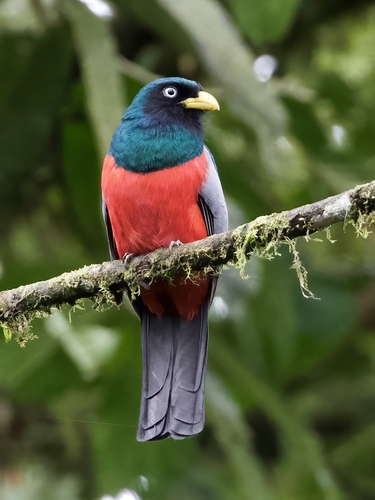
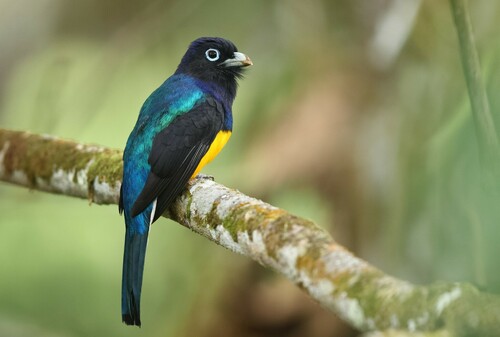
Males have dark blue head and upper breast (which appears blackish in poor light), a green back that becomes bluer on the rump, orange-yellow lower underparts, black wings with white vermiculation, an almost entirely white undertail with only a very narrow black base to each feather, and a complete pale bluish eye-ring.
Female Plumage
Females resemble males, but have a grey back, head, and breast, with rather indistinct black-and-white barring that occurs mainly on the inner webs of each tail feather, with less barring on the outer webs.
Gartered Trogon Distinction
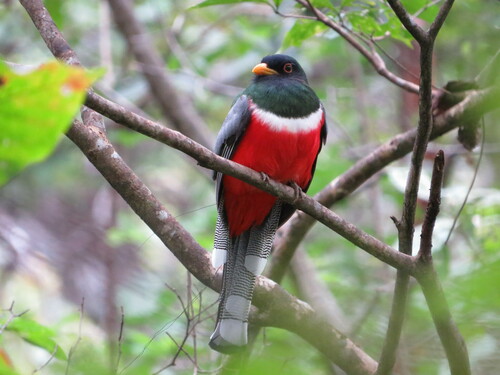
The similar smaller gartered trogon (T. caligatus) can be distinguished by its yellow eye-ring in males, incomplete white eye-ring in females, and different undertail patterning in males.
Green-backed Trogon Distinction
There is no distribution overlap between the white-tailed trogon and the green-backed trogon, but the two species can still be separated by undertail pattern: unlike the white-tailed trogon, male green-backed trogons have a broad black base to each feather, and female green-backed trogons have relatively distinct black-and-white barring mainly on the outer webs of each feather.
Male white-tailed trogons also have a bluer rump than green-backed trogons.
Vocalization
The song of the white-tailed trogon is made up of 15 to 20 very fast cow notes.
Perching Behavior
White-tailed trogons typically perch upright and motionless.
Flight Behavior
Although their flight is fast, they are reluctant to fly long distances.
Morphological Adaptations
Their broad bills and weak legs reflect their diet and arboreal habits.
Diet
They feed mainly on small fruit, supplemented by arthropods — arthropods make up a slightly larger proportion of their diet in the dry season when fruit is scarce.