About Trogon mexicanus Swainson, 1827
Common Name and Length
Trogon mexicanus, commonly known as the mountain trogon, measures 11.5–12.5 inches (29–31.5 cm) in length.
Weight
It weighs between 61.5 and 85 grams (2.2 and 3.0 ounces), with an average weight of 71 grams (2.5 ounces).
Sexual Dimorphism
Like all trogons, this species is sexually dimorphic, meaning males and females have distinct physical appearance.
Adult Male Upperparts Plumage
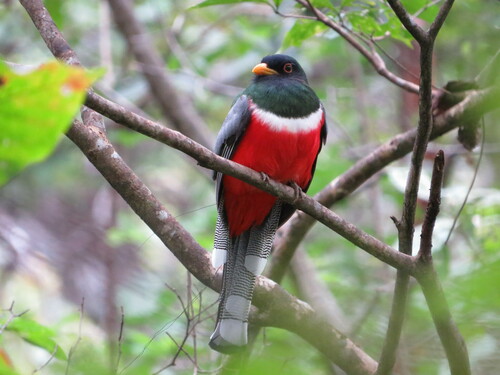
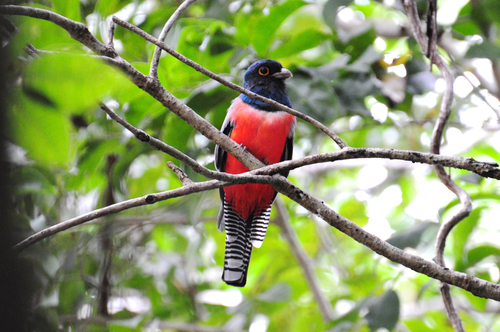
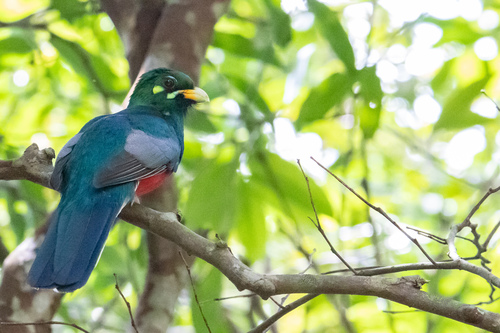
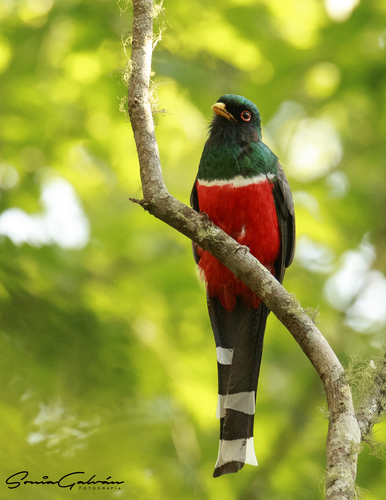
Adult males have green plumage on the crown, nape, and upperparts. The upper side of their tail is bluish-green, with black tips on the tail feathers (rectrices).
Adult Male Head Features
Their face and throat are blackish, with an orange-red ring around the eye and a bright yellow bill.
Adult Male Torso Plumage
The chest is green, and the belly and undertail are red; these two color regions are separated by a narrow white band.
Adult Male Undertail Pattern
The underside of the tail is black, with three large white patches formed by white tips on the outer rectrices.
Adult Male Wing Features
The primary flight feathers are blackish, and the wing coverts have black and white wavy fine streaks (vermiculations).
Adult Female Upperparts Plumage
Females have warm brown plumage on the head and upperparts. The upperside of their tail is rufous-brown, with black tips on the rectrices.
Adult Female Head Markings
They have a small white crescent mark in front of the eye, and a distinct bold white crescent behind the eye. The upper half of their bill is dark.
Adult Female Torso Plumage
Their chest is warm brown, and a narrow white band separates this upper chest from the brown lower chest and red belly.
Adult Female Undertail Pattern
The undertail is patterned black and white: the outer webs of the rectrices are barred black and white, while the inner webs are black with broad white tips.
Adult Female Wing Features
The primary flight feathers are blackish with white outer webs, which form white streaks along the folded wing. The wing coverts are pale brown with dusky vermiculations.
Core Distribution Range
The mountain trogon is native to the highlands of Mexico, Guatemala, and Honduras.
El Salvador Occurrence
While it was previously recorded as a resident species in El Salvador, the area where it was found was transferred to Honduras in 1992, so it now only occurs in El Salvador as a vagrant.
Nicaragua Occurrence
It has also been recorded in Nicaragua, though the origin of these Nicaraguan individuals is uncertain.
Texas Specimen Record
There is a specimen of the mountain trogon held in the ornithological collection at Vassar College that is reported to have been shot in Texas, but the species is not included on the list of accepted bird species of North America.
Elevation and Habitat
The mountain trogon occurs at elevations between 3,000 and 10,000 feet (910 to 3,050 m), and prefers pine or pine-oak woodlands and cloud forest.
Diet and Feeding Behavior
It feeds on insects and small fruits, which it catches or plucks while in flight.