About Apaloderma narina (Stephens, 1815)
Sexual Dimorphism Overview
This bird species, Apaloderma narina, is sexually dimorphic, and males have brighter colouring than females.
Upperparts Plumage
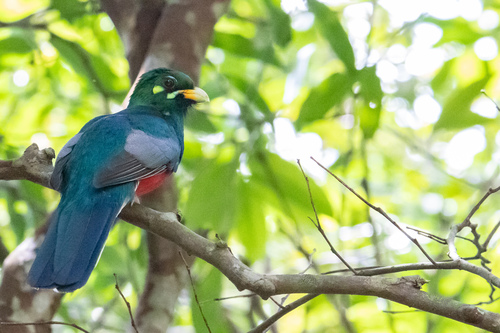
Both sexes have vivid, gingery green plumage on their upperparts.
Tail Feather Appearance
Their tail feathers have a metallic blue-green gloss. The outer three tail feathers (rectrices) on each side are tipped and fringed with white, which gives the undertail of perched birds a characteristic white appearance, unlike the bar-tailed trogon.
Wing Feather Coloration
The wing coverts are grizzled grey, and most flight feathers (remiges) are colourless grey.
Male Plumage and Bare Parts
Males in particular have bright amaranth red plumage on their underparts, along with bare green gape and eye flanges.
Female Plumage and Bare Parts
Females have brown plumage on their face and chest, blue skin circling the eyes, and duller red plumage on the underparts.
Immature Bird Characteristics
Immature birds look similar to females, but have distinct white tips on their inner wing tertials, and less distinct gape and eye flanges.
Species Name Etymology
The species name comes from the Khoi word for flower, which was recorded by Francois Levaillant in his description of the bird; Levaillant also used the name Narina for his Gonaqua mistress.
General Range Size
This species has a large range across Africa.
Habitat Types
It inhabits lowland to highland valley and riparian forests, across tropical to temperate regions.
Seasonal Dispersal Behavior
Populations living in highlands disperse seasonally to lower elevations.
Detailed Geographic Distribution
Its distribution extends from Sierra Leone to Ethiopia, and from East Africa to eastern and southern South Africa.
Conservation Status
Because of its wide range and broad habitat tolerance, the Narina trogon is classified as a species of least conservation concern.