About Trogon violaceus J.F.Gmelin, 1788
Species Identification and Size
The Guianan trogon (Trogon violaceus J.F.Gmelin, 1788) is 23 to 25 cm (9.1 to 9.8 in) long and weighs 38 to 57 g (1.3 to 2.0 oz). Males and females have very different plumage.
Adult Male Head and Breast Plumage
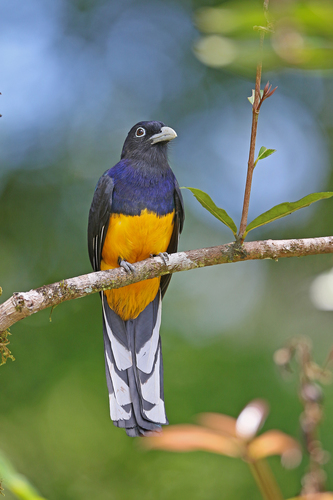
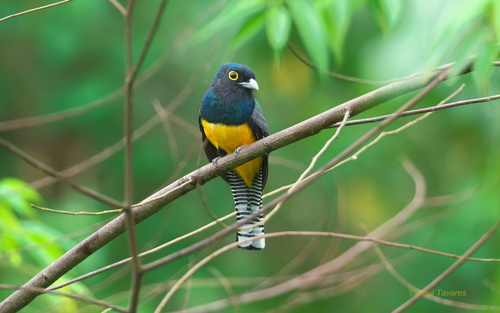
Adult males have a violet-blue head with a black mask and throat; their bill is pale blue-gray, and their dark eye is surrounded by bare pale yellow skin. The violet-blue coloring of their head extends to the middle of their breast, where a narrow white band separates it from the bright yellow of the rest of their underparts.
Adult Male Upperparts and Wings
Their upperparts are bright metallic green, and their wings are so finely marked with black and white that they appear dark gray-brown.
Adult Male Tail Features
The upper surface of their tail is violet-blue with black feather tips; the lower surface has fine black and white bars and wide white feather tips.
Adult Female Head and Facial Features
Adult females have a blackish culmen on their bill, and white arcs above and below the eye on their face.
Adult Female Upperparts and Wings
Their head and upperparts are dark gray, and their wings are thinly but densely barred black and white.
Adult Female Underparts
Their belly is a duller yellow than the male's, and has a gray wash on the flanks.
Adult Female Tail Features
The underside of their tail appears barred along its sides.
Juvenile Male Appearance
Juvenile males have browner wings and less white on their undertail than adult Guianan trogons.
Juvenile Female Appearance
Juvenile females match the appearance of adult females.
Vocalizations
The Guianan trogon's song is a long series of rapid hollow downslurred whistles: kyu-kyu-kyu-kyu-kyu-kyu. Its calls include rolling chattering.
Movement Pattern
The Guianan trogon is non-migratory.
Geographic Range
It is found in eastern Venezuela, the Guianas, and adjacent northern Brazil.
Habitat Types
It inhabits a variety of semi-open landscapes, including savanna, edges and openings of primary forest, young secondary forest, cacao and coffee plantations, and terra firme forest.
Elevation Range
In Venezuela, it ranges up to an elevation of 1,200 m (3,900 ft).