About Trogon curucui Linnaeus, 1766
Size and Weight
The blue-crowned trogon (Trogon curucui Linnaeus, 1766) is approximately 24 cm (9.4 in) long and weighs 39 to 63 g (1.4 to 2.2 oz).
Nominate Male Head and Upperbody Plumage
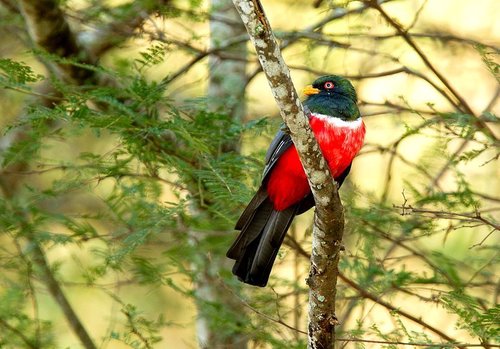
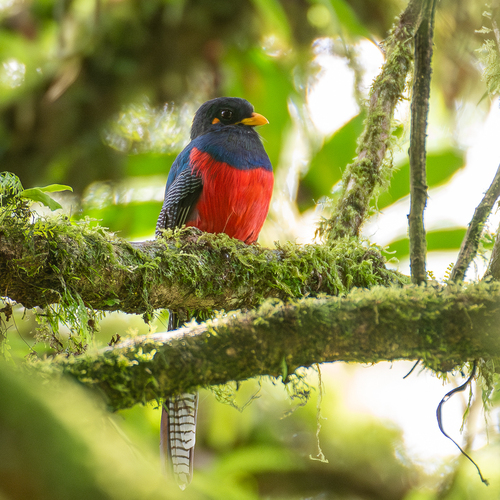
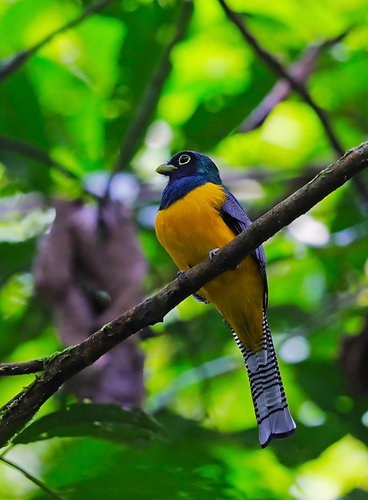
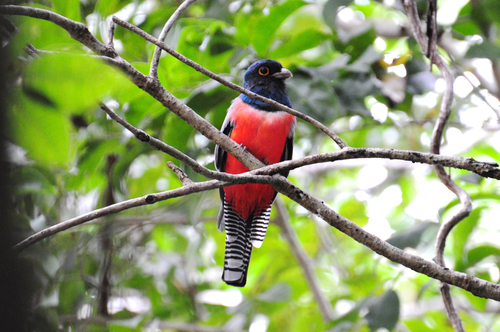
The male of the nominate subspecies has a blackish face and throat, with an orange ring surrounding its eye. Its crown, sides of the neck, and breast are glossy greenish blue, its nape is turquoise-green, and its back is metallic bronzy green.
Nominate Male Tail and Wing Plumage
The upperside of its tail is greenish blue, while the underside has black and white bars. The folded wing has fine vermiculation that appears gray when viewed from a distance.
Nominate Male Underbody Plumage
A white band separates its breast from its rosy red belly and vent.
Nominate Female Plumage
The female is gray in all the areas where the male is green, and its belly is pinkish red. Instead of the male's orange eye ring, the female has white arcs before and after its eye.
Nominate Female Tail Pattern
The underside of the female's tail has a different black and white pattern from the nominate male.
T. c. peruvianus Male Plumage
The male of the T. c. peruvianus subspecies has a bluish gloss on its bronzy green back, a much reduced white breast band, and narrower white bars on its undertail.
T. c. behni Male Plumage
The male of the T. c. behni subspecies has a more intensely bronzed back than the nominate subspecies male, and its breast is greener.
Male Vocalizations
The song of the male blue-crowned trogon is a fast, evenly paced repetition of "kow" notes that lasts around 4 to 5 seconds and ends abruptly.
Shared Vocalizations
Both sexes produce a "churrr" call.
Overall Species Range
The blue-crowned trogon is found throughout the Amazon Basin south of the Amazon River, and also extends south and east of this area.
Nominate Subspecies Range
The nominate subspecies ranges from Amazonian central Brazil east to the Atlantic Ocean.
T. c. peruvianus Range
T. c. peruvianus lives in the Andean foothills of southern Colombia, eastern Ecuador and Peru, and northwestern Bolivia, and extends east into Amazonian Brazil as far as the Tapajós River.
T. c. behni Range
T. c. behni is found in eastern and southern Bolivia, southwestern Brazil, most of Paraguay, and northern Argentina.
Habitat Types: Forest
Across its large range, the species lives in a variety of landscapes. Forest habitats it occupies include várzea, gallery, tall secondary, and dry semi-deciduous forest.
Vegetation Level Usage
It can be found at all vegetation levels from the understory up to the canopy.
Habitat Types: Non-forest
It also occurs in savanna woodland, dry palm forest, caatinga, and scrublands.
Northern Range Elevation Limits
In the northern part of its range, it rarely occurs above 500 m (1,600 ft) in elevation.
Southern Range Elevation Limits
It reaches elevations as high as 1,500 m (4,900 ft) in Argentina and 1,750 m (5,700 ft) in Bolivia.