About Trogon massena Gould, 1838
Trogon massena, commonly called the slaty-tailed trogon, is a species of trogon, a group where males and females have distinctively different plumage; all trogons have soft, often colorful, feathers.
Size
Adult slaty-tailed trogons measure 30 to 35.5 cm (12 to 14 inches) in total length and weigh approximately 140 to 155 g (4.9 to 5.5 ounces).
Nominate Male Head Features
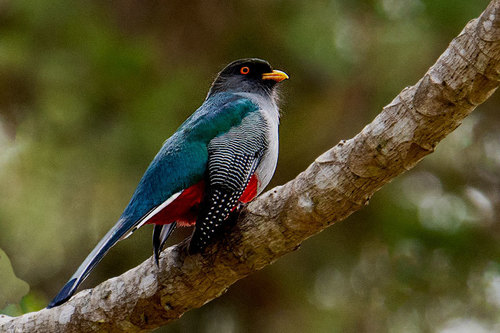
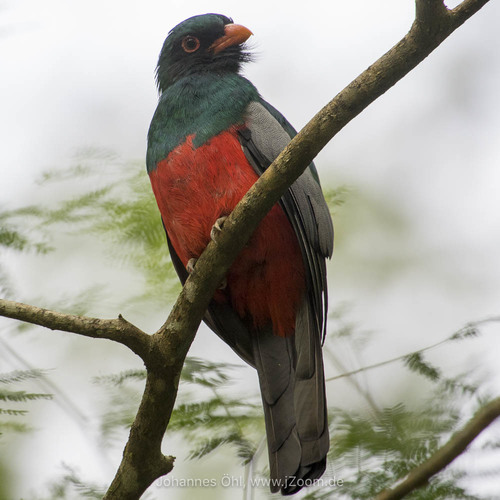
The nominate subspecies male has an orange-red bill, along with a dull black face, chin, and upper throat, and a red to orange ring encircling the eye.
Nominate Male Upperparts
Its upperparts are metallic green: the back tends toward golden green, while the crown and rump are bluish green.
Nominate Male Underparts
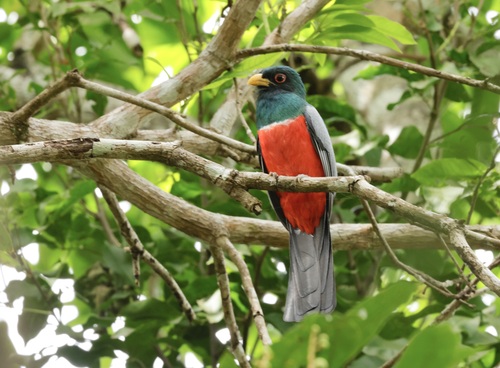
The breast is metallic green, and the belly and vent are a deep red.
Nominate Male Wing Features
The folded wing has fine black and white vermiculation that appears gray when viewed from a distance.
Nominate Male Upperside Tail
On the upperside of the tail, the four central feathers are metallic green to bronzy green with black tips, the next pair are mostly black, and the outermost pair are entirely black.
Nominate Male Underside Tail
The undersides of the tail feathers are slate gray with black tips.
Female Plumage
The female of the species replaces most of the male's green plumage with gray; this gray is paler on the upper breast than on the upperparts.
Female Tail and Bill
The upperside of the female's tail is black, and her maxilla is dusky gray.
Subspecies Overview
Three subspecies are recognized.
T. m. hoffmanni Male Traits
The male T. m. hoffmanni has essentially the same plumage as the nominate subspecies, but the upperside of its tail is more golden.
T. m. australis Size
T. m. australis is smaller than the nominate subspecies.
T. m. australis Plumage Differences
Compared to the nominate, male T. m. australis have bluish green uppertail, darker gray female plumage, browner undertail on males, and more extensive metallic green on the face and throat of males.
Nominate Subspecies Distribution
In terms of distribution and habitat, the nominate subspecies occurs on the Caribbean slope from southern Mexico, through Belize, Honduras, and Guatemala, into Nicaragua.
T. m. hoffmanni Distribution
T. m. hoffmanni occurs on both the Caribbean and Pacific slopes of Costa Rica and Panama, and is also found in extreme northwestern Colombia.
T. m. australis Distribution
T. m. australis occurs in western Colombia and far northwestern Ecuador.
Habitat Preferences
The species primarily lives in the midstory to canopy of tropical evergreen forest and mature secondary forest, and it can also be found in gallery forest, coffee plantations, and mangroves.
Northern Elevation Range
It is a lowland species, reaching only 600 m (2,000 ft) in elevation in Mexico and northern Central America.
Southern Elevation Range
Locally, it can be found as high as 1,200 m (3,900 ft) in Costa Rica, 1,400 m (4,600 ft) in Panama, and 1,100 m (3,600 ft) in Colombia.