About Priotelus roseigaster (Vieillot, 1817)
Trogon Family Traits
Trogons, the group this species belongs to, are brightly colored birds with long, strongly graduated tails, small feet, and short, thick bills.
Species Plumage
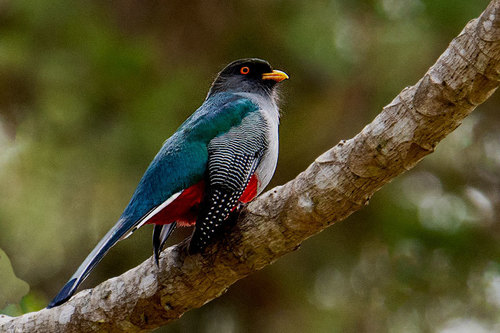
This species, the Hispaniolan trogon (Priotelus roseigaster), has metallic green upperparts, a gray throat and breast, and a red belly. It can be distinguished from the closely related Cuban trogon by its more typical tail.
Tail Morphology
The underside of its tail is dark, and each rectrix has a broad white tip.
Sexual Dimorphism
Males and females look similar to one another, but female wing coverts and secondaries lack the narrow white bars found on males.
Male Morphometrics
Average measurements for males are 135.2 mm for the wing, 154 mm for the tail, 17.3 mm for the culmen from the base, and 16.8 mm for the tarsus.
Female Morphometrics
Average measurements for females are 136.6 mm for the wing, 154 mm for the tail, 16.5 mm for the culmen from the base, and 16.4 mm for the tarsus.
Habitat Types
Its natural habitats are subtropical or tropical moist montane forests and heavily degraded forest. It can also inhabit rainforest, dry forest, pine forest, and broadleaved deciduous forest.
Threat Status
It is threatened by habitat loss, and is mostly confined to a few remaining protected areas.
Historical Mangrove Records
Several early records note the species in mangrove swamps west of Miragoane, but it is unknown whether these were visiting birds or a resident population.
Nesting Habitat Requirements
It requires large, old, decayed trees with holes for nesting.
Elevation Range
It primarily occurs at elevations between 500 and 3000 m, but appears to undergo some altitudinal migration, with individuals observed at lower elevations in winter.
Haiti Population Distribution
Due to extensive habitat loss, in Haiti it is restricted to the Massif de la Hotte and Chaîne de la Selle.
Dominican Republic Population Status
It is still quite common in the Dominican Republic, especially in the relatively undisturbed Sierra de Baoruco, although it has experienced a moderately rapid population reduction caused by deforestation.
Breeding Season
Its breeding season is thought to run from March to July.
Nesting Sites
It nests in tree cavities, including cavities created by the Hispaniolan woodpecker (Melanerpes striatus).
Clutch Characteristics
The only known clutches for this species contain two eggs; the eggs are pale green and unmarked.
Egg Measurements
Recorded egg measurements range from 27.9 by 23.5 mm to 31.4 by 23.9 mm.
Nesting Period Unknowns
The length of the incubation period and nestling period are not known.
Generation Length
Generation length is estimated at 7.3 years.