About Harpactes whiteheadi Sharpe, 1888
Sexual Dimorphism Note
Like most trogons, Whitehead's trogon (Harpactes whiteheadi Sharpe, 1888) is sexually dimorphic, with males being far more colorful than females.
Size
It is one of the largest trogon species found on Borneo, ranging from 29 to 33 cm (11 to 13 inches) in total length.
Male Head Coloration
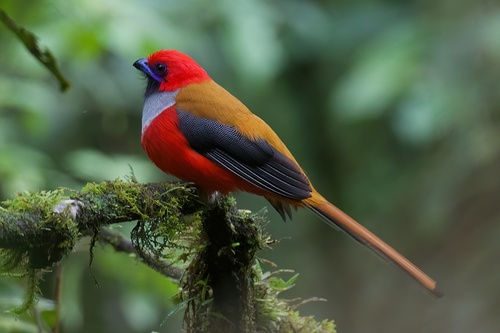
For adult males, the forehead, crown, nape, and sides of the head are crimson, with bare blue skin surrounding the eyes.
Male Upperparts Coloration
The rest of the male's upperparts are cinnamon-brown.
Male Underparts Coloration
The male has a black throat that fades into a grey breast, while all other underparts are crimson.
Male Wing Features
The male's wings are mainly black, with fine white barring on the secondaries and coverts.
Male Tail Underside
The underside of the male's tail is mostly white.
Male Tail Uppercase
On the upper side, the two central tail feathers are cinnamon with a broad black tip, and the rest of the tail feathers are primarily black.
Male Outermost Tail Feathers
The outermost tail feathers have white on the terminal half and along the outer web.
Male Soft Parts
Males also have a blue beak, pinkish-brown legs and feet, and reddish-brown irises.
Female Plumage
Adult females share the same overall pattern as males, but their plumage is much duller, and all areas that are crimson on males are cinnamon-brown on females.
Female Wing Barring
The barring on females' secondaries and wing coverts is cinnamon-brown instead of white.
Immature Female Plumage
Immature females resemble adult females, but their entire ventral side is uniformly colored, and they lack the adult female's black throat and grey upper breast.
Immature Female Beak Color
Immature females also have less blue coloration on their beaks.
Distribution and Elevation Range
Whitehead's trogon is endemic to the island of Borneo, where it lives in mountainous areas at elevations between 900 and 2,000 metres (3,000 and 6,600 ft).
Habitat Preferences
It is restricted to primary forest, and prefers damp valleys.
Population Status
It is an uncommon, poorly studied resident species.