About Tridentiger trigonocephalus (Gill, 1859)
Maximum Size
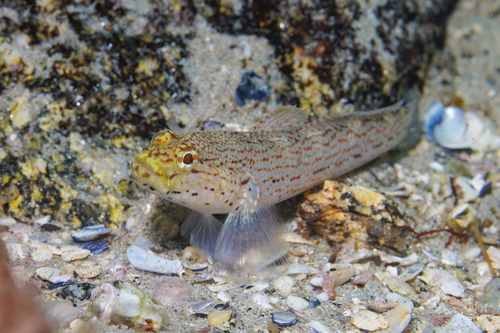
Tridentiger trigonocephalus, commonly known as the chameleon goby, reaches a maximum total length of 11 centimetres (4.3 inches).
Base Body Coloration
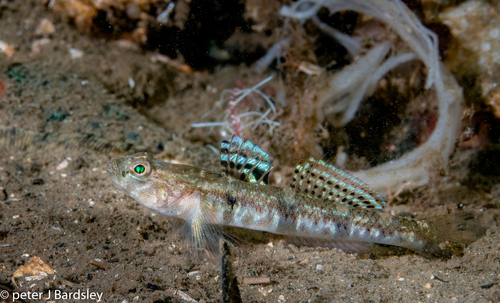
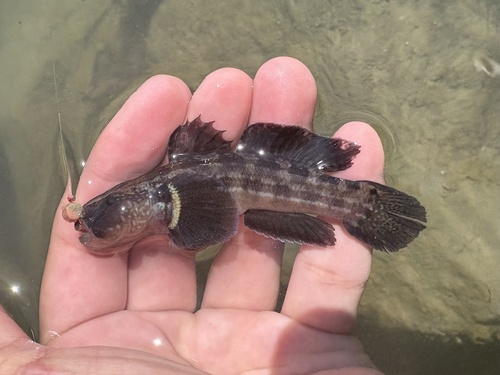
Its base body color is pale greyish-brown, with a white-speckled head and two longitudinal black bands that run along the flank from the head to the caudal peduncle.
Fin Coloration
Both of its dorsal fins may have white speckles and a brown longitudinal stripe, and the anal fin has an orange or grey band running across its centre.
Color Change Ability
In certain conditions, this fish can darken its overall color to the point that the black bands become nearly invisible.
Morphological Differences from Tridentiger bifasciatus
This species is very similar in appearance to the Shimofuri goby (Tridentiger bifasciatus), but differs in several key traits: the chameleon goby has no white spots on the underside of its head, and has a white margin along its second dorsal fin and anal fins.
Tridentiger bifasciatus Distinguishing Traits
In contrast, T. bifasciatus has white spots on both the upper and lower sections of the head, and an orange-red margin on the second dorsal and anal fins, while lacking the distinctive stripes that T. trigonocephalus has on these fins.
Salinity Preference Differences
The two species also differ in preferred habitat salinity: T. bifasciatus prefers waters with a salinity lower than 22 parts per thousand, while T. trigonocephalus prefers higher salinity environments.
Native Geographic Range
The chameleon goby is native to the eastern coast of Asia, with a native range that includes Japan, Korea, China, and Siberia.
Non-Native Distribution Records
There have been confirmed reports of this species found in the Black Sea, and it was recently recorded in the eastern Mediterranean Sea at Ashdod harbour, Israel.
Habitat Type
It is a demersal fish that lives and feeds near the seabed, and can be found in bays and rocky coasts, as well as in brackish water and freshwater lakes.
Hiding Behavior
It typically hides in crevices, under stones, inside burrows, or among seagrasses.