About Trichoglossus rubritorquis Vigors & Horsfield, 1827
Nomenclature and Size
The red-collared lorikeet (scientific name Trichoglossus rubritorquis Vigors & Horsfield, 1827) measures around 26 centimetres (10 inches) long.
Head and Neck Plumage
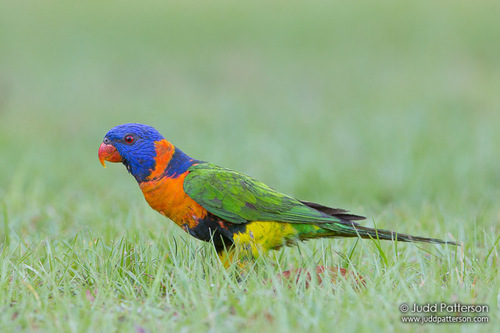
The feathers of its head and throat are dark brown with blue shafts, and it has an orange-red band on the back of the neck. Its chest is orange with red, and the base of the hindneck is dark blue.
Body and Limb Appearance
The wings are green, the bill is red, and the legs and feet are grey-brown.
Sexual and Juvenile Plumage
Males and females have similar plumage, while juvenile red-collared lorikeets have duller plumage and a dark bill.
Similar Species Distinction
This species can be distinguished from the rainbow lorikeet: rainbow lorikeets have a green nape instead of a red one, lack a blue mantle, and have more yellow-green underparts.
Range Overlap
The two species may both be found in areas where their ranges meet east of the Gulf of Carpentaria.
Distribution Range
The red-collared lorikeet is distributed across northern Australia, ranging from King Sound in Western Australia to the Gulf of Carpentaria.
Habitat
It inhabits woodland, open forest, and rainforest, and has readily adapted to urban environments, so it can be found in towns and cities.
Movement Patterns
The species is sedentary, but it moves to follow available food supplies; for example, it visits flowering banksias on Groote Eylandt in April and May.