About Poicephalus robustus (Gmelin, 1788)
General Morphology
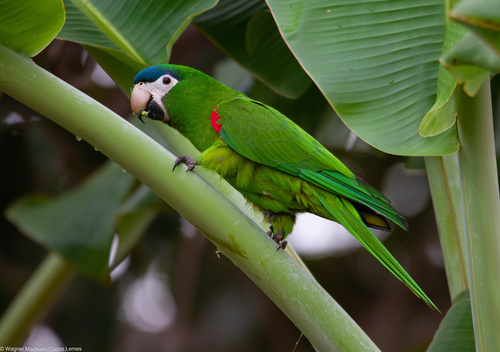
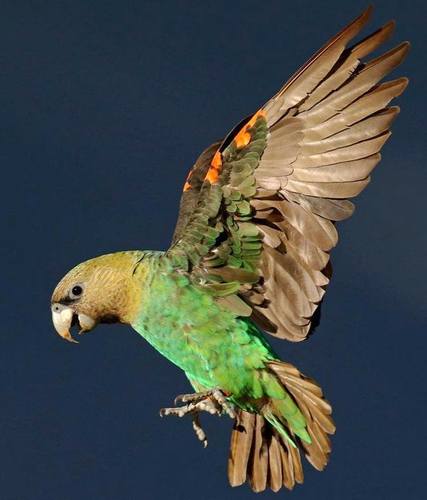
The Cape parrot (Poicephalus robustus) is a moderately large, short-tailed bird with a very large beak.
Beak Adaptation
This beak is adapted to crack all kinds of hard nuts and fruit kernels, especially those from African yellowwood trees of the genus Podocarpus.
Feeding Specialization Comparison
This feeding specialization differs from its close relative, the savanna-dwelling Poicephalus fuscicollis, which feeds on a wide range of trees from tropical woodlands, including marula, Commiphora species, and Terminalia species.
Sexual Dimorphism
Cape parrots are sexually dimorphic: females typically have an orange frontal patch on the forehead.
Juvenile Plumage
Juveniles also have a larger orange-pink forehead patch, but they do not have the red plumage on the shoulders and legs that adult birds show.
Plumage Variation
These plumage traits vary between individual birds and across the three recognized forms of the species.
Endemic Range
The Cape parrot is endemic to South Africa.
Habitat Type and Altitude
It lives in Afromontane forests at moderate altitudes in eastern South Africa, ranging from the coastal escarpment near sea level up to midlands at around 1000 meters.
Forest Dominant Vegetation
These Afromontane forests form a series of small patches across southern and eastern South Africa, and are dominated by three yellowwood species: Podocarpus latifolius, Podocarpus falcatus, and Podocarpus henkelii.
Distribution Pattern
Cape parrots have a disjunct distribution.
Largest Population Range
The largest population is centered in the Amathole mountains of Eastern Cape Province, and extends east with several large gaps through the Mthatha escarpment and Pondoland in Eastern Cape, and across the southern midlands of KwaZulu-Natal Province to Karkloof near Pietermaritzburg.
Small Northern Population
A very small population of around 30 individuals lives over 600 kilometers further north, in the Magoebaskloof area of Limpopo Province.
Unoccupied Forest Areas
Cape parrots are not found in large sections of Afromontane forest, including the forests along South Africa's southern coast near Knysna, the higher altitude Afromontane forests in the Drakensberg mountains of KwaZulu-Natal, and the moderate-altitude forests of northern KwaZulu-Natal province and Eswatini.
Population Separation
These unoccupied areas separate the KwaZulu-Natal midlands population from the Limpopo escarpment population.
Historical Distribution Notes
All these unoccupied areas fall within the typical dispersal range of Cape parrots, and there are historical records of Cape parrots from northern KwaZulu-Natal.