About Tilia platyphyllos Scop.
Growth Form
Tilia platyphyllos Scop. is a narrowly domed tree with a moderate growth rate. It can eventually reach a height of 40 metres (130 ft), though open-grown individuals growing away from other trees are more typically 20–25 m tall.
Bark Characteristics
Young stems are reddish-brown, and mature trees develop dark grey bark marked with fine fissures and furrows. Branches spread upwards at wide angles. Twigs are reddish-green and slightly covered in soft short hairs.
Leaf Arrangement
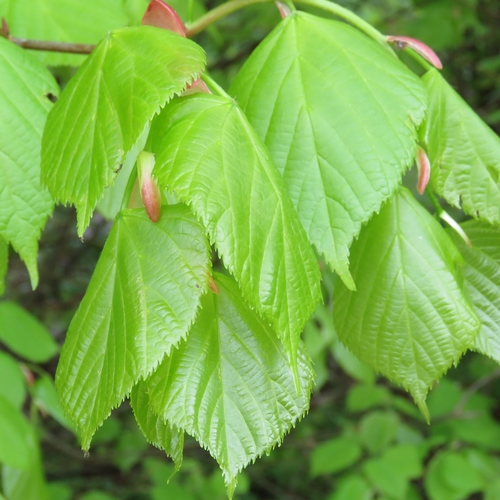
Its foliage is made up of simple, alternately arranged leaves. As suggested by its common name, the leaves of this species are larger than those of the related small-leaved lime Tilia cordata; they are usually 6 to 9 cm long and broad, and can reach up to 15 cm in exceptional cases.
Leaf Shape and Color
Leaves are ovate to cordate in shape, with a mid to dark green colour on both the upper and lower surfaces. Except for the subspecies pseudorubra, the underside of leaves has white downy hair, especially along the veins.
Leaf Morphology Details
Leaves taper to a sharp mucronate tip, have a sharply serrated margin and a cordate base, and feature pinnate venation arranged along a central midrib. The pubescent leaf stalk (petiole) is usually 3–4 cm long, and ranges from 1.5–5 cm. Autumn foliage turns yellow-green to yellow.
Flower Inflorescence
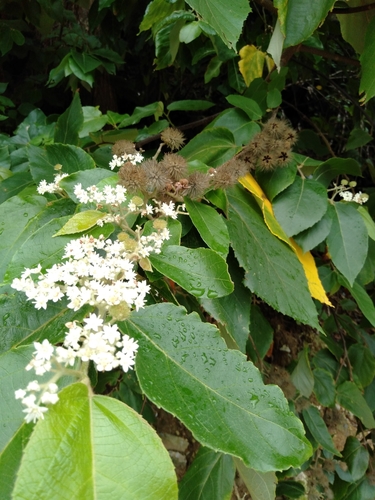
The small, fragrant yellowish-white flowers grow in drooping cymose clusters of 3 to 4. Each cluster is accompanied by a whitish-green, leaf-like bract with an oblong-obovate shape. The bent flower stalks (geniculate peduncles) measure 1.5–3 cm long.
Flower Structure
The flowers are hermaphroditic, with 5 sepals, 5 petals, and numerous stamens, but lack staminodes. They have a superior ovary with 2–10 locules and one smooth style.
Pollination
Flowers are pollinated by bees and some butterflies, most notably the White-letter Hairstreak.
Fruit Characteristics
The fruit is a round greenish-grey nutlet, 9–12 mm long by 8–10 mm in diameter. It has a woody shell marked with five prominent ridges; these ridges distinguish it from all other limes except Tilia chinensis, and the nutlet is usually covered in dense short hairs between the ridges.
Ornamental Cultivation
Tilia platyphyllos is widely planted across the temperate world as an ornamental tree for parks and city streets. Many cultivars are available, including the golden-leaved 'Aurea', 'Fastigiata', the torn-leaved 'Laciniata', the columnar 'Örebro', the narrow-crowned 'Princes Street', the red-twigged 'Rubra', the twisted-branched 'Tortuosa', and the upswept-branched 'Tiltstone Filigree'.
Cultivar Award
The cultivar 'Rubra' has received the Royal Horticultural Society's Award of Garden Merit.
Traditional Utilization
The wood of Tilia is used for carving, and almost all parts of the tree can be used for fodder, ropes, or firewood. Historically, bast and honey were the main products obtained from Tilia, and this may have been an important factor in the spread of the species and its status as a typical agroforestry tree in the Middle Ages.
Landscape Uses
Tilia species are also important for amenity use, shelterbelts, and game plantings in open landscapes, urban areas, and recreational forestry.
Medicinal Properties
This plant contains tannins that act as an astringent. Its wood is burned to make charcoal, which is ingested to treat intestinal disorders, and used topically to treat edema or infections such as cellulitis of the lower leg.