About Sterculia setigera Delile
Taxon Identity and Growth Form
Sterculia setigera Delile is a deciduous tree that can grow up to 18 meters tall.
Crown and Trunk Base Characteristics
It has an open, spreading crown and a buttressed base.
Bark Morphology
Its grey-purple bark peels away in thin, irregular scales, leaving pale patches on the trunk; a cut into the bark reveals fibrous, brownish to red inner bark and a white exudate.
Leaf Arrangement and Venation
Its leaves are simple and arranged alternately, with palmate venation at the base, and form 5 entire or pointed lobes.
Leaf Blade Features
The leaf blade is ovate to orbicular in outline, and the upper surface is typically stellate and tomentose.
Inflorescence and Calyx Traits
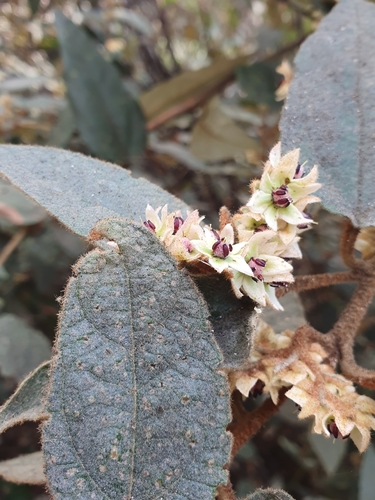
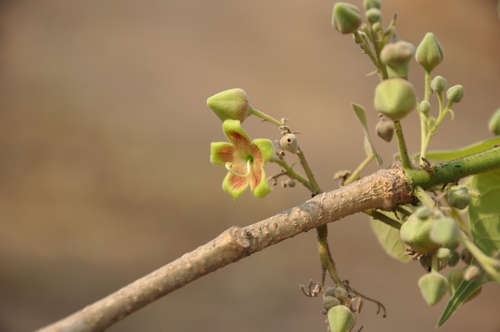
Its inflorescences are racemes, with a 5-lobed calyx that reaches up to 12 mm in diameter; the outer surface of the calyx is green, while the inner surface is purple-red.
Flowering Period
Flowering occurs toward the end of the dry season, between February and April.
Fruit Characteristics
The fruit is a sessile, oblong follicle, 6–10 cm long, grey-green or brown in color, and contains many seeds.
Persistent Follicles
Empty follicles can remain attached to the tree even after the seeds have fallen out.
Species Distribution Range
This species occurs from Senegal eastward to Sudan and Ethiopia, and also grows in Angola.
Habitat Preferences
It is found in savanna ecological zones, and occurs frequently on hills, on rocky soils, and in shallow gritty soils.
Traditional Seed Use
Nomadic groups in Northern Nigeria eat the seeds of this widespread species, which has multiple uses for various local communities.
Medicinal Bark Use
A decoction made from stem bark extract is used as part of an herbal treatment regimen for skin ailments and infections, fever, diarrhea, and toothache.