About Thylogale billardierii (Desmarest, 1822)
Physical Appearance
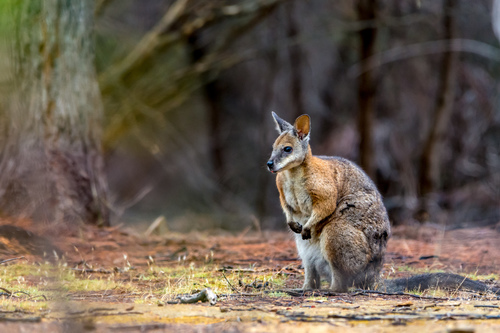
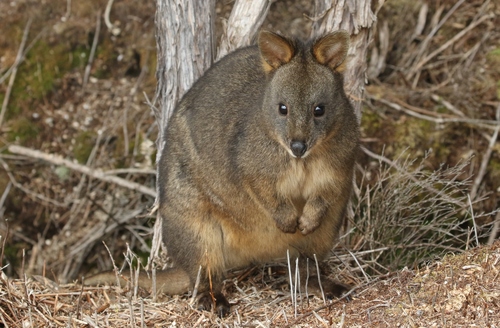
The Tasmanian pademelon, Thylogale billardierii, has a compact body, short rounded ears, thick fur covering its limbs, head, and body, and a tail covered in short hairs. Most of its body is covered in greyish fur, while its underparts range from yellowish to rufous. Unlike most other pademelons, it has no distinct markings on its face or hips.
Size and Sexual Dimorphism
Adult males grow to around 6.5 kg (14 lb) in weight, and 70–120 cm (28–47 in) in total length including a 30–45 cm (12–18 in) tail. Males are considerably larger than females, which average 4.6 kg (10 lb).
Current Distribution
Tasmanian pademelons are abundant and widespread across mainland Tasmania, and are also found on the nearby King and Furneaux Islands.
Historical Range and Extirpation
They were formerly distributed across all of southeastern Australia, including areas south of the Great Dividing Range in Victoria and the Limestone Coast of South Australia. They were extirpated from the Australian mainland by the 19th century, mainly due to habitat loss and predation by introduced red foxes.
Habitat Preferences
The species prefers rainforest, sclerophyll forest, and scrubland, but also uses wet gullies in dry open eucalyptus forest. Locations of this type that are adjacent to open feeding areas are especially favoured.
Diet
The Tasmanian pademelon is a herbivore that feeds on a wide variety of plants, including herbs, green shoots, grass, and some nectar-bearing flowers.
Predators
Historically, the Tasmanian pademelon was part of the diet of the now-extinct thylacine. It is still preyed on by other living Tasmanian predators, including Tasmanian devils, quolls, eagles, dogs, and feral cats.
Human Use and Management
Because they are abundant, Tasmanian pademelons are occasionally culled alongside other wallabies to reduce competition for grass with farmed animals. Hunting of the species is allowed; its pelt has some economic value, and its meat is considered palatable.
Breeding Season
The Tasmanian pademelon does not have a fixed breeding season, though most births take place in autumn.
Mating Behaviour
Males regularly sniff females within their range, and pursue females that are receptive. Females are only receptive to mating for around 24 hours at a time. Copulation can be lengthy, and occurs in several bouts, with resting periods of up to 15 minutes between each bout.
Gestation and Birth
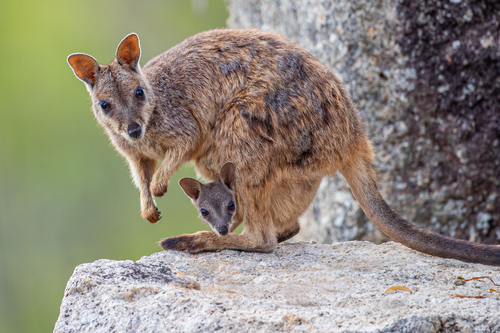
Gestation lasts 30 days. Newborn young measure around 16 mm (0.63 in) in total length at birth, and quickly move to the mother’s pouch where they attach to one of four teats.
Pouch Development
They grow relatively slowly compared to other marsupials of the same size. Their eyes open between 18 and 20 weeks after birth, and their fur first develops between 20 and 22 weeks after birth. They are fully furred by around 160 days of age, at which point they first begin to poke their head out of the pouch.
Post-Pouch Development
The first time they emerge fully from the pouch can happen any time from 160 days up to around 190 days of age. They continue to suckle for another three months after full emergence, after which the mother becomes aggressive towards them.
Reproductive Cycle
A mother often gives birth to a second joey while she is still nursing an older offspring that has already left the pouch. On average, female Tasmanian pademelons produce 1.3 young per year.
Maturity and Lifespan
Males reach sexual maturity at 17 months old, while females reach sexual maturity at 13 months old. Lifespan in the wild has not been confirmed, but is estimated to be between 5 and 6 years.