About Thalasseus elegans (Gambel, 1849)
Common Name and Classification
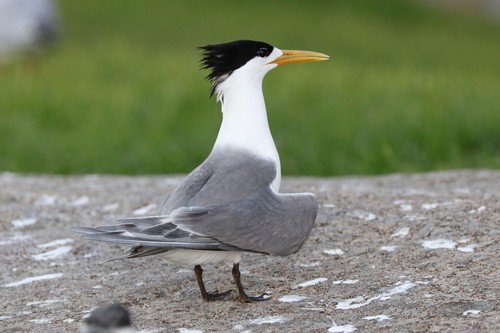
Thalasseus elegans, commonly known as the elegant tern, is a medium-large tern species.
Morphological Features
It has a long, slender, slightly downcurved orange bill, pale gray upperparts, white underparts, and black legs.
Size Measurements
Adults measure 39–42 cm (15–17 in) in length, have a wingspan of 76–81 cm (30–32 in), and weigh 190–325 g (6.7–11.5 oz).
Non-breeding Plumage
From late summer through winter, the elegant tern's forehead turns white.
Crest Characteristics
The black crest extending down from the crown runs through the eye, leaving a small black smudge in front of the eye even in winter plumage.
Similar Species Crest Differences
This differs from royal terns, where the black crest stops at the eye, and from lesser crested terns, which have a less shaggy crest.
Juvenile Plumage
Juvenile elegant terns have a scalier pale gray back.
Vocalization
Their call is a characteristic loud grating noise similar to other terns in the Thalasseus genus.
Royal Tern Comparison
Elegant terns are easily confused with royal terns, but royal terns are larger, have thicker bills, and show more white on the forehead in winter.
Lesser Crested Tern Comparison
Vagrants outside the species' normal range in Europe are often confused with lesser crested terns, but elegant terns differ by having a pure white (rather than gray) rump, being slightly paler on the upperparts, and having a slightly longer, more slender, slightly downcurved bill.
Global Population
The total global population of elegant terns is around 90,000 breeding pairs, with the majority located on islets in the Gulf of California.
Nesting and Clutch
The species nests in a scrape dug into the ground, and lays one or two eggs per clutch.
Predator Defense Behavior
Unlike some smaller terns of the Sterna genus, elegant terns are not very aggressive toward potential predators.
Anti-predation Strategies
Instead, they rely on the high density of their nests (often only 20–30 cm apart) and nesting close to more aggressive species such as Heermann's gulls to avoid predation.
Heermann's Gull Predation
Even so, Heermann's gulls do prey on some elegant tern eggs and chicks.
Primary Predators
More significant predators are the larger, more predatory western gulls and yellow-footed gulls.
2021 Bolsa Chica Incident
In May 2021, a drone crash-landed near an elegant tern nesting colony at the Bolsa Chica Ecological Reserve.
Drone Crash Impact
The crash scared off 2,500 nesting elegant terns, leading to the abandonment of 1500 nests containing thousands of eggs and a catastrophic reproductive loss for the colony.