About Ichthyaetus leucophthalmus (Temminck, 1825)
Nomenclature
This species is the white-eyed gull, with the scientific name Ichthyaetus leucophthalmus (Temminck, 1825).
Breeding Adult Head Plumage
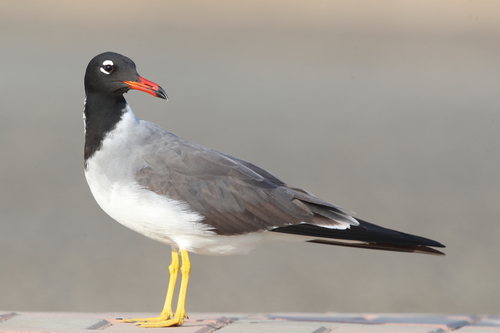
In breeding plumage, adult white-eyed gulls have a black hood that extends down to the upper throat. The lower edge of the hood along the sides of the neck is bordered by a narrow white bar.
Breeding Adult Body Plumage
The upperparts and inner upperwings are medium-dark grey. The breast is mid-grey, while all other underparts are white.
Breeding Adult Wing & Tail Plumage
The secondaries are black with a white trailing edge, and the primaries are black. The underwing is dark, and the tail is white.
Non-Breeding Adult Plumage
Adults in non-breeding plumage follow a similar pattern, but the black hood is marked with small, scattered white flecks. White-eyed gulls gain their full adult plumage when they are two to three years old.
Juvenile Plumage
Juvenile birds have very different plumage: their head, neck and breast are chocolate brown. Their upperparts and upperwings are covered in brown feathers with broad pale fringes, and they have a black tail.
First Winter Plumage
In their first winter, birds develop greyer feathering on the head, breast and upperparts.
Second Winter Plumage
Second-winter plumage is much closer to adult plumage, but lacks the full black hood.
Bill Characteristics
A distinct feature of white-eyed gulls at all ages is their long, slender bill. The bill is black in younger birds. In adults, the bill is deep red with a black tip.
Leg Characteristics
The legs are yellow; they are the dullest yellow in younger birds, and the brightest yellow in adults in breeding plumage.
Eye Feature Naming Origin
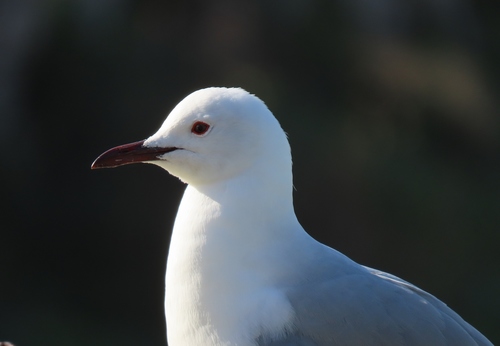
Contrary to its common name, the eye of this gull is not actually white. The species gets its name from white eye-crescents, which are present at all ages.
Breeding Distribution & Timing
For distribution, the white-eyed gull breeds on inshore islands with rocks and sandy beaches—including the Siyal Islands—in the Red Sea, from July to September.
Non-Breeding Distribution
For the remainder of the year, it can be found throughout the Red Sea, with some individuals traveling as far as Oman and Somalia.