About Thalassarche chlororhynchos (Gmelin, 1789)
Scientific Name and Length
The Atlantic yellow-nosed albatross (Thalassarche chlororhynchos) has an average length of 81 cm (32 in).
Head and Neck Coloration
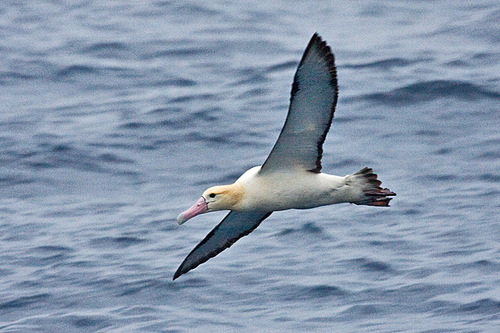
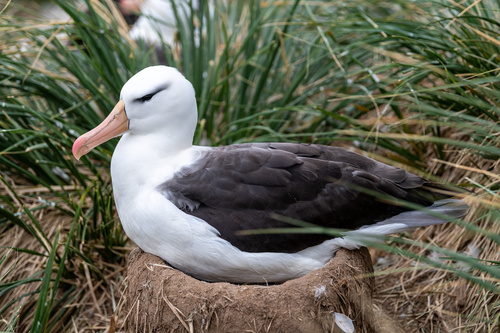
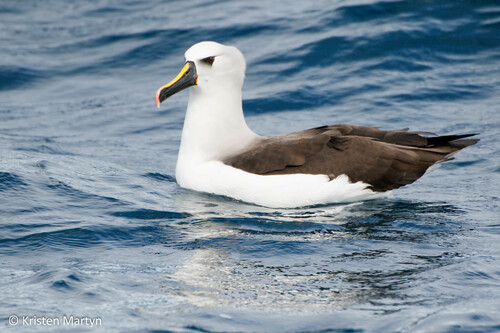
It is a typical black-and-white mollymawk with a grey head and a large eye patch; its nape and hindneck are white.
Bill Appearance
Its bill is black, with a yellow culminicorn and a pink tip.
Saddle, Wing and Underpart Coloration
It has a blackish grey saddle, tail, and upperwing, while its underparts are predominantly white.
Underwing Markings
A narrow black margin appears on its underwing and primaries.
Juvenile Appearance
Juvenile Atlantic yellow-nosed albatrosses are similar to adults, but have a white head and a black bill.
Distinction from Indian Yellow-nosed Albatross
This species can be told apart from the Indian yellow-nosed albatross by its darker head.
Distinction from Other Mollymawks
Compared to other mollymawks, it can be distinguished by its smaller size (with particularly narrow wings) and the thin black edging on the underwing.
Distinction from Grey-headed Albatross
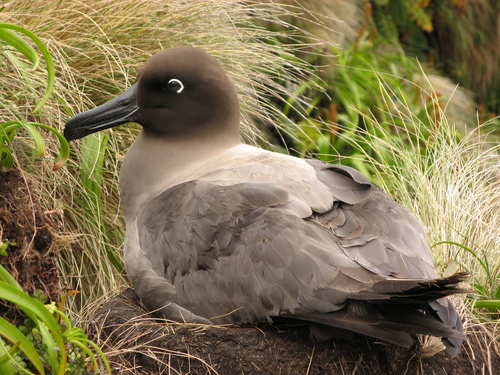
The grey-headed albatross shares a similar grey head, but has more extensive, less well-defined black markings around the edge of the underwing.
Distinction from Salvin's Albatross
Salvin's albatross also has a grey head, but has much broader wings, a pale bill, and even narrower black borders to the underwing.
Nesting Islands
Atlantic yellow-nosed albatrosses nest on islands in the mid-Atlantic, including the Tristan da Cunha archipelago (Inaccessible Island, Middle Island, Nightingale Island, Stoltenhoff Island) and Gough Island.
At-sea Range
When at sea, their range spans the south Atlantic from South America to Africa, between 15°S and 45°S.