About Thalassarche melanophris (Temminck, 1828)
Taxonomy and Size
The black-browed albatross, with the scientific name Thalassarche melanophris (Temminck, 1828), is a medium-sized albatross. It measures 80 to 95 cm (31–37 in) in length, has a wingspan of 200 to 240 cm (79–94 in), and an average weight of 2.9 to 4.7 kg (6.4–10.4 lb). Its natural lifespan can exceed 70 years.
Adult Plumage
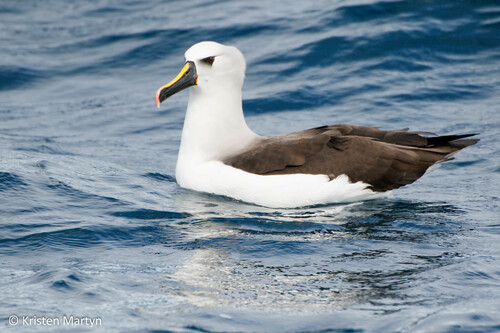
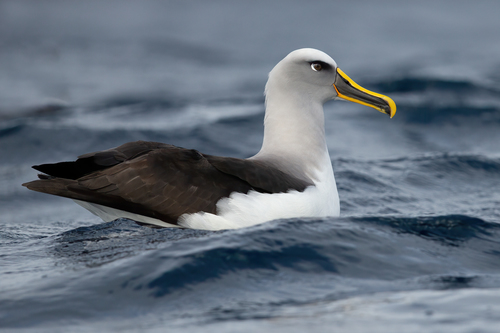
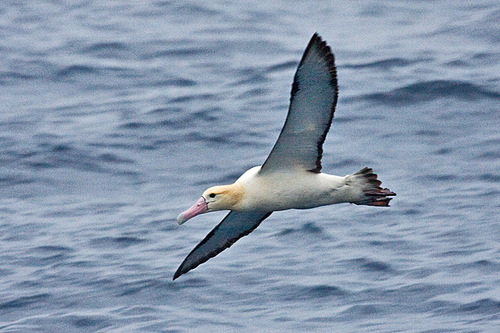
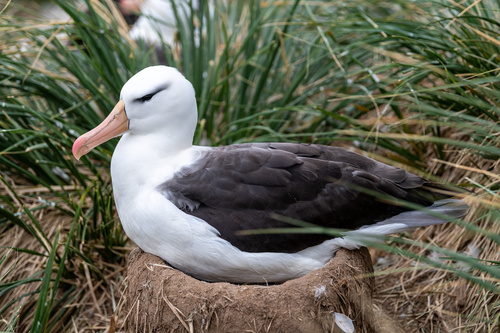
It has a dark grey saddle and upperwings that contrast with its white rump and underparts. Its underwing is mostly white, with broad, irregular black margins. It has a dark eyebrow, and a yellow-orange bill with a darker reddish-orange tip.
Juvenile Plumage
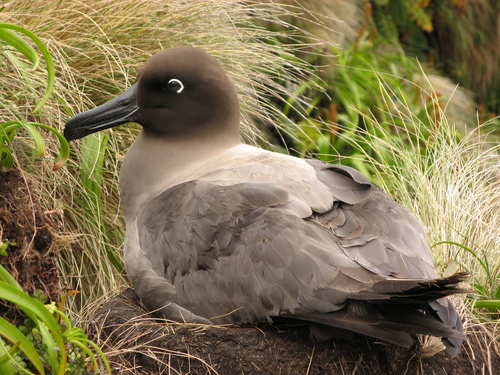
Juveniles have dark horn-colored bills with dark tips, a grey head and grey collar, and dark underwings.
Species Distinguishing Features
Features that distinguish it from other mollymawks, except the closely related Campbell albatross, include the dark eyestripe that gives the species its common name, a broad black edge along the white underside of its wings, a white head, and an orange bill tipped with darker orange. Campbell albatrosses are very similar but have a pale eye. Immature black-browed albatrosses resemble grey-headed albatrosses, but grey-headed albatrosses have entirely dark bills and more extensive dark head markings.
General Distribution
The black-browed albatross has a circumpolar range across the southern oceans, and breeds on 12 islands within this range.
Atlantic Breeding Sites
In the Atlantic Ocean, it breeds on the Falkland Islands, South Georgia, the South Sandwich Islands, and the Cape Horn Islands.
Pacific Breeding Sites
In the Pacific Ocean, it breeds on Islas Ildefonso, Diego de Almagro, Islas Evangelistas, Campbell Island, Antipodes Islands, Snares Islands, and Macquarie Island.
Indian Breeding Sites
In the Indian Ocean, it breeds on the Crozet Islands, Kerguelen Islands, Heard Island, and McDonald Island.
Population Estimate
A 2005 population count estimated there are 1,220,000 living black-browed albatrosses, totaling 600,853 breeding pairs.
Breeding Pair Distribution
Of these breeding pairs, 402,571 breed in the Falklands, 72,102 breed on South Georgia Island, and 120,171 breed on the Chilean islands of Islas Ildefonso, Diego de Almagro, Islas Evangelistas, and Islas Diego Ramírez. 600 breeding pairs are found on Heard Island, and the remaining 5,409 pairs breed on the other breeding islands.
Foraging Habitat Preferences
This albatross species prefers to forage over shelf and shelf-break areas.
Regional Foraging Ranges
Black-browed albatrosses from the Falkland Islands winter near the Patagonian Shelf, while birds from South Georgia forage in South African waters using the Benguela Current. Chilean birds forage over the Patagonian Shelf and the Chilean Shelf, and may travel as far as New Zealand.
Northern Occurrences
Due to a northerly migratory tendency, this species is the albatross most likely to be found in the North Atlantic. There have been 20 possible sightings of the black-browed albatross in the Continental United States.
Nesting Habitat
For reproduction, this species normally nests on steep slopes covered with tussock grass, and sometimes on cliffs; however, on the Falklands it nests on flat coastal grassland.
Egg Laying Timing
It is an annual breeder, and lays one egg between 20 September and 1 November. Breeders from the Falklands, Crozet, and Kerguelen lay their eggs approximately three weeks earlier.
Incubation Period
Both sexes share incubation duties, which last 68 to 71 days.
Chick Development
After hatching, chicks take 120 to 130 days to fledge.
Juvenile Breeding Maturity
Juveniles return to the colony after two to three years, but only to practice courtship rituals, as they do not start breeding until around their 10th year.