About Phoebastria albatrus (Pallas, 1769)
Scientific Classification and Size Overview
The short-tailed albatross, scientifically named Phoebastria albatrus (Pallas, 1769), is a medium-sized albatross. It has a wingspan of 215 to 230 cm (85–91 in), a body length of 84 to 94 cm (33–37 in), and a body weight ranging from 4.3 to 8.5 kg (9.5–18.7 lb).
Standard Morphometric Measurements
Standard measurements for the species are as follows: the bill measures 12.7–15.2 cm (5.0–6.0 in) long, the tail measures 14–15.2 cm (5.5–6.0 in) long, the tarsus measures around 10 cm (3.9 in), and the wing chord measures 51 cm (20 in).
Adult Plumage and Head Coloration
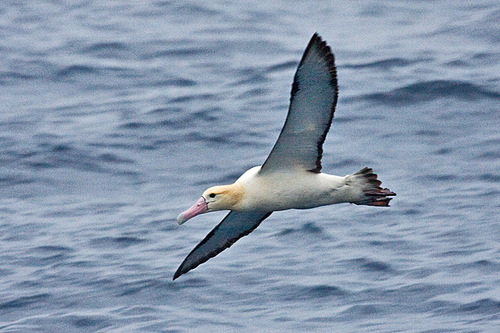
Adult short-tailed albatrosses have an overall white plumage, with black flight feathers, some coverts, and a black terminal bar on the tail. They have a yellow-stained nape and crown.
Adult Bill Characteristics
Their bill is large and pink, and older individuals develop a blue tip on the bill.
Juvenile Plumage Maturation
Juveniles are entirely brown all over, and gradually become whiter as they mature over a period of 10 to 20 years.
Sympatric Species Distinction
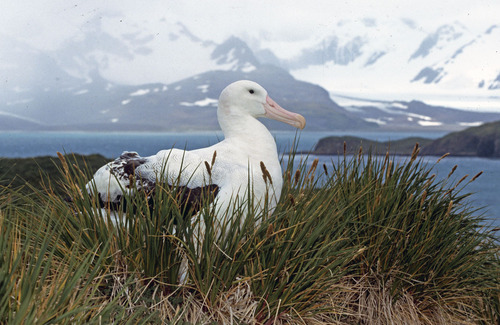
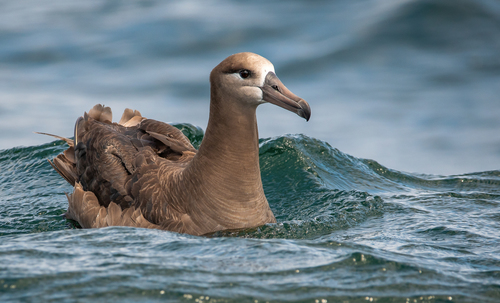
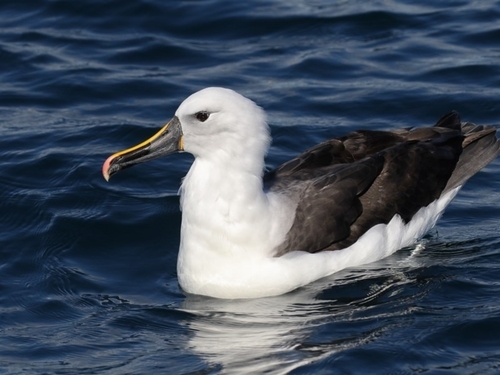
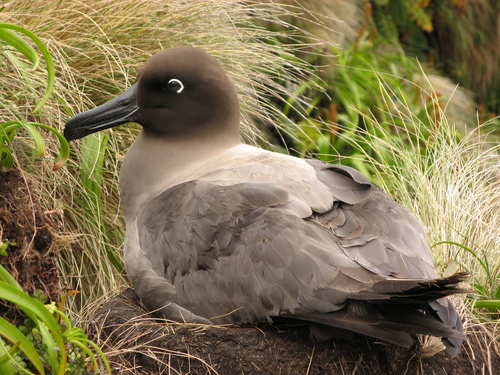
It can be told apart from the two other albatross species that share its range—Laysan albatross and black-footed albatross—by its larger size, pink bill with a bluish tip, and specific plumage details.
Tail Length Comparison
Contrary to its common name, its tail is not shorter than the tails of Laysan or black-footed albatrosses, and it is actually longer than the tail of the waved albatross, another member of the genus Phoebastria.
Current Nesting Island Locations
Currently, short-tailed albatrosses nest on four islands. The majority of the population nests on Tori-shima, and almost all remaining nesting birds are found on Minami-kojima in the Senkaku Islands.
Northwestern Hawaiian Islands Nesting Records
A female-female pair started nesting on Kure in the late 2000s, and a chick hatched on 14 January 2011 on Midway. Both Kure and Midway are located in the Northwestern Hawaiian Islands.
Bonin Islands Nesting Record
In 2012, a pair began incubating an egg on Muko-jima, which is part of Japan’s Bonin Islands.
Non-breeding Geographic Range
During the non-breeding season, the species ranges across the North Pacific. Males and juveniles gather in the Bering Sea, while females feed off the coast of Japan and eastern Russia. Individuals can be found as far east as California.
Conservation Listing Status
Short-tailed albatross is listed on a number of U.S. state endangered species lists, including Washington’s.
Extirpated Historical Breeding Sites
The species no longer breeds as a result of extirpation at Kita-no-shima, Enewetak Atoll, Kobishi, and multiple sites in the Bonin Islands (Nishino Shima, Yomejima, and Mukojima, until very recently). It also formerly bred on Bermuda during the Pleistocene epoch.
Historical Nesting Habitat Preference
Historically, this albatross preferred to nest in large open areas near stands of the grass Miscanthus sinensis.
Breeding Age Onset
Short-tailed albatrosses usually begin breeding for the first time when they reach 10 years of age.
Egg Characteristics
A clutch contains one dirty white egg marked with red spots that are mostly concentrated at the egg’s blunt end. The egg typically measures 116 by 74 millimetres (4.6 in × 2.9 in), and incubation lasts around 65 days.
Incubation Behavior
Both sexes share incubation duties.