About Taricha sierrae (Twitty, 1942)
Species Description
Taricha sierrae, commonly known as the Sierra newt, has the following description.
Adult Coloration
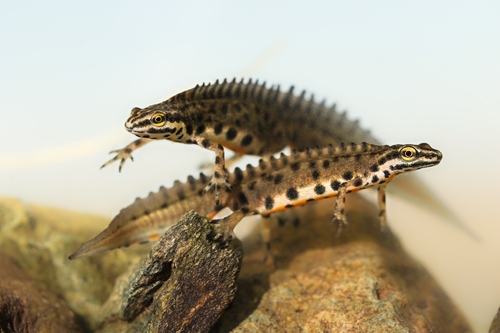
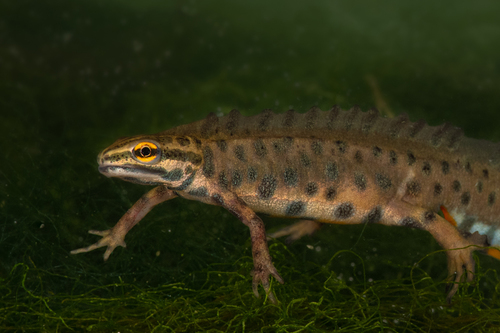
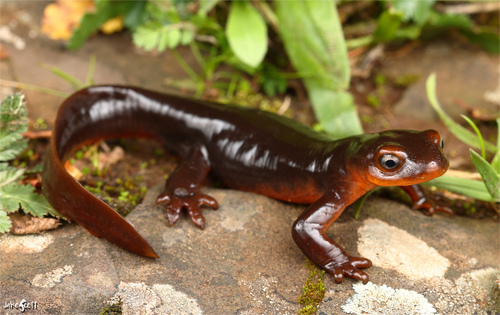
Adult Sierra newts have body coloring that ranges from yellowish-brown to dark brown, burnt orange, and sometimes yellowish. The area around their eyelids and below their eyes is lighter than the rest of the head. Their irises are light silvery to pale yellow, and when viewed from above, their eyes extend to or beyond the outline of the head.
Breeding Season Traits
During the mating season, breeding males develop smooth skin, a flattened tail that aids swimming, a swollen cloaca, and rough nuptial pads on the undersides of their feet that help them hold onto females. Breeding females develop more vascular skin, may grow a small tail blade, and have more prominent vents.
Larval Appearance
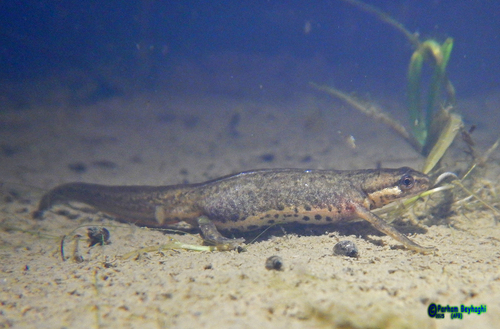
Aquatic larvae live in ponds, and are light yellow with two regular, narrow dark bands on the back. Older larvae commonly have dark spots or blotches along their sides.
Warning Coloration
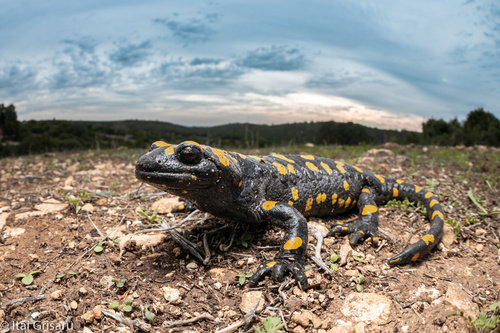
The reddish or orange underside coloring of Sierra newts, while it might appear to attract predators, signals to predators that the newts are poisonous and acts as a predation deterrent.
Range and Habitat
Geographic Distribution
Sierra newts are found primarily between the Cascades and Sierra Nevada, at elevations up to around 2000m.
Climate Preference
They prefer less humid climates than rough-skinned newts.
Seasonal Habitat Shifts
This species migrates seasonally between aquatic and terrestrial habitats. Outside of the breeding season, newts are terrestrial and shelter in rock crevices and logs within forests, woodlands, and shrublands. During the breeding season, they migrate to aquatic areas to mate and lay eggs.
Reproduction
Breeding Timeline
Reproduction for Sierra newts generally occurs between March and early May. Adults typically return to the hatching pool between January and February.
Mating Process
After a mating dance, the male mounts the female and rubs his chin on her nose. He then attaches a spermatophore to the substrate, which the female retrieves into her cloaca.
Egg Mass Features
A female's egg mass holds between 7 and 30 eggs, and has a consistency similar to thick gelatin dessert. Egg masses are most often attached to stream plant roots or rocky crevices in small, slow-moving pools, but they have also been found attached to underwater rocks or leaf debris.
Breeding Pool Depth
While these pools are broadly considered shallow, they are relatively deep compared to the average depth of a Southern California stream, ranging from 1 to 2 metres (3.3 to 6.6 ft) deep.
Adult Breeding Period
Adult newts remain in the pools throughout the breeding season, and can occasionally be found there well into summer.
Egg Incubation
Larvae hatch from early to midsummer, depending on local water temperature. Incubation length typically ranges from 14 to 52 days, varying primarily with water temperature.
Larval Camouflage
Larvae are hard to find in streams because they blend in well with the sandy bottom they usually stay close to.
Sexual Maturation Timeline
After the larval period, which usually ends in late summer or early fall, newts move to terrestrial habitats and do not return to breed for 5 to 8 years.
Defense and Predator Dynamics
Unken Reflex
When a predator approaches, Sierra newts hold their legs out to the sides, tilt their head back to expose the orange ventral surface, and straighten their tail. This defensive posture is called the unken reflex, which is seen in other amphibian species.
Tetrodotoxin Properties
Like other members of the genus Taricha, skin glands of Taricha sierrae secrete the potent neurotoxin tetrodotoxin, which is hundreds of times more toxic than cyanide. This is the same toxin found in pufferfish and harlequin frogs.
Toxin Production Origin
While tetrodotoxin was previously thought to be produced through a symbiotic relationship with bacteria, this idea has been disproved.
Toxin Risk Level
The neurotoxin is strong enough to kill most vertebrates, including humans, but is only dangerous if ingested or enters the bloodstream.
Natural Predators
Due to their high tetrodotoxin concentrations, Sierra newts have very few natural predators. Garter snakes, specifically Thamnophis couchii and T. sirtalis, have genetic adaptations that let them prey on Taricha newts.
Coevolutionary Arms Race
Genetic mutations that let snakes metabolize the toxin created selective pressure that favors newts producing higher tetrodotoxin concentrations. Increased newt toxicity then creates further selective pressure favoring snakes with greater toxin resistance. This evolutionary arms race has resulted in Sierra newts producing toxin levels far higher than what is needed to kill any other typical predator.