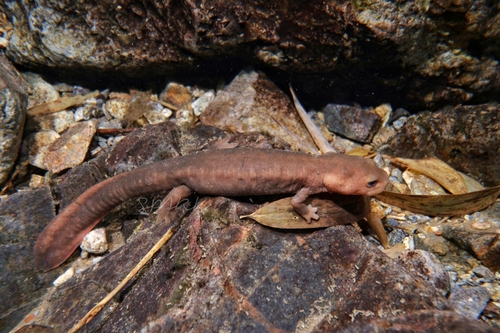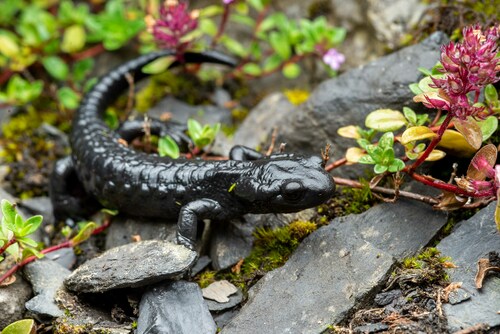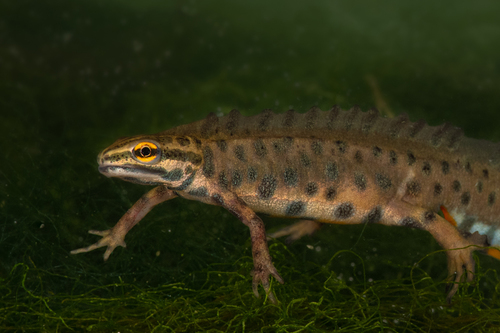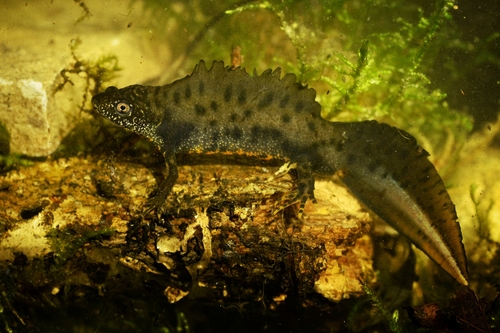
About Lissotriton schmidtleri (Raxworthy, 1988)
Scientific Nomenclature
Schmidtler's smooth newt, scientifically known as Lissotriton schmidtleri, is a species of newt.
Distribution
Its distribution extends from northwestern Greece and southeast Bulgaria, through East Thrace, across the Bosphorus, to northwestern Anatolia. The range of this species borders the ranges of three other related newt species: the common smooth newt L. vulgaris to the north, the Greek smooth newt L. graecus to the west, and Kosswig's smooth newt L. kosswigi to the east.
Taxonomic History
In 1988, Christopher Raxworthy first described this taxon as Triturus vulgaris schmidtleri, a subspecies of the smooth newt. When genetic data later indicated that the smooth newt actually represents a complex of multiple distinct lineages, Pabijan and colleagues reclassified Schmidtler's smooth newt as a separate full species in 2017, and this classification has been accepted by all subsequent authors.
Distinguishing Trait Overview
This species differs most noticeably from other species in the smooth newt species complex in male secondary sexual characteristics that appear during the breeding season.
Size
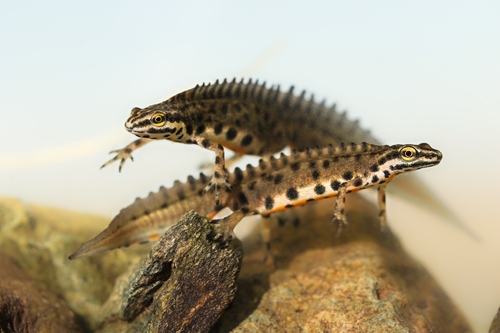
Overall, it is very similar to the common smooth newt, but it is smaller: males only reach a length of 5–7 cm (2.0–2.8 in).
Breeding Male Dorsal Crest
During breeding, the male's dorsal crest grows to 2 mm or more in height and has a jagged, denticulated edge.
Breeding Male Tail Structure
The end of the tail is elongated, but unlike the tail of the closely related Kosswig's smooth newt, it does not have a filament.
Body Structure
The species' body is slightly square in cross-section, but it lacks dorso-lateral folds. Toe flaps for swimming are only weakly developed.
Paedomorphism
There have been reports of paedomorphic adult individuals of Schmidtler's smooth newt, which retain larval traits into adulthood.
IUCN Conservation Status
The species is currently assessed as least concern on the IUCN Red List, but it is experiencing ongoing decline in both the extent and quality of its habitat, so its total population is thought to be decreasing.
Vulnerability Assessment
Since its total range is much smaller than the range of the entire smooth newt species complex, it is likely more vulnerable to threats than earlier estimates suggested.