About Salamandra lanzai Nascetti, Andreone, Capula & Bullini, 1988
Head and Body Size
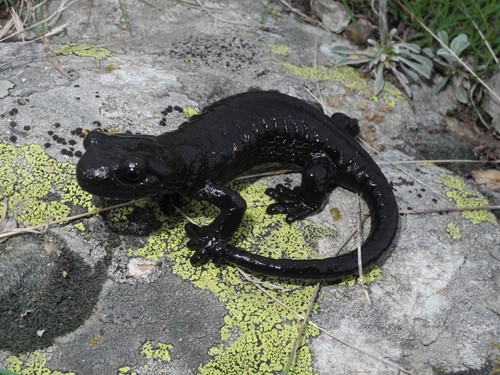
Salamandra lanzai has a flat head, with a total body length ranging from 115 to 160 millimetres (4.5 to 6.3 inches).
Tail and Gland Features
The tip of its tail can be either rounded or pointed, and the species may or may not have paravertebral glands.
Coloration
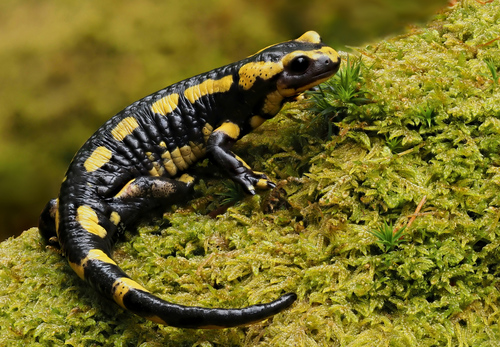
It is solid black in color, making it similar in appearance to the related alpine salamander Salamandra atra.
Confirmed Distribution
This species is distributed in the Cottian Alps near Monviso, the Guil Valley of southeastern France, and northwestern Italy, specifically the Germanasca Valleys, Pellice Valleys, and along the Po River.
Unconfirmed Distribution Records
Its presence in Chisone Valley is unconfirmed. An old specimen held in the Museo La Specola in Florence suggests the species may also occur in the Maritime Alps.
General Elevation Range
Salamandra lanzai inhabits elevations between 1,200 and 2,600 m (3,900 and 8,500 ft), with a recorded maximum elevation of 2,800 m (9,200 ft).
Country-Specific Elevation Ranges
In France, it occurs at elevations of 1,800 to 2,300 metres (5,900 to 7,500 ft), while in Italy it is found between 1,450 and 2,100 metres (4,760 to 6,890 ft).
Habitat Types
Its typical habitats include subalpine prairies, fresh humid woodlands and forests, and the banks of mountain streams.
Diet
The diet of Salamandra lanzai consists of a variety of insects, spiders, and multiple slug species.
Mating Period
Mating takes place on land between May and October.
Activity During Breeding
During this breeding period, the species is mostly nocturnal, but individuals may be active during the day when there is heavy rain.
Mating Timing Variation
Most mating occurs in May, but the timing varies based on annual climate conditions.
Gestation and Reproduction
After successful mating, gestation lasts three to four years, after which the female gives birth to two to six fully formed live young.