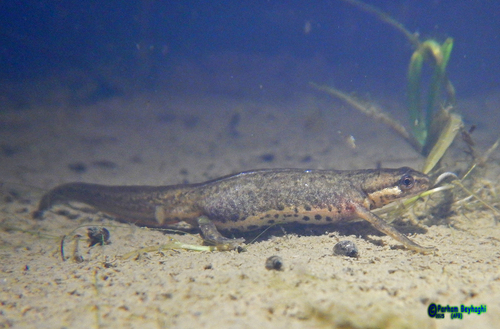
About Lissotriton lantzi (Wolterstorff, 1914)
Taxonomy and Nomenclature
The Caucasian smooth newt, also called the Caucasian newt, scientifically known as Lissotriton lantzi, is a species of newt native to the Caucasus region.
Distribution Range
Its confirmed range extends from the mouth of the Don river in Russia to Georgia; it may also be present in Armenia, Azerbaijan, extreme northeastern Turkey, and Iran.
Elevation Range
This species occurs at elevations ranging from sea level up to 2,500 m (8,200 ft).
Initial Taxonomic Description
Willy Wolterstorff first described this taxon in 1914 as Triton vulgaris subsp. typica forma lantzi, a form of the smooth newt, which is now classified as Lissotriton vulgaris.
Subspecies Rank
The taxon was later elevated to the rank of subspecies.
Species Status Recognition
After genetic data indicated that the smooth newt actually represents a complex of multiple distinct lineages, Dubois and Raffaëlli recognised several former smooth newt subspecies, including the Caucasian smooth newt, as separate full species in 2009.
Classification Acceptance
This classification has been accepted by subsequent authors.
Distinguishing Traits
The Caucasian smooth newt differs from other species in the smooth newt species complex primarily in male secondary sexual characteristics that appear during the breeding season.
Male Dorsal Crest
In breeding males, the dorsal crest reaches a height of 1 mm or more, and has almost spine-shaped denticles.
Male Tail Features
The tail gradually tapers to a fine point, but does not have a distinct terminal filament.
Male Body Characteristics
The body is slightly square in cross-section, but lacks dorso-lateral folds.
Limb Traits
Toe flaps are moderately developed.
Paedomorphism Record
Paedomorphic adult individuals of this species have been recorded.
IUCN Evaluation Status
The International Union for Conservation of Nature has not yet evaluated the conservation status of this species separately from the broader smooth newt.
Extinction Vulnerability
Because the Caucasian smooth newt has a much smaller total range than the entire smooth newt species complex, it is likely more vulnerable to extinction than previously estimated.
Potential Range Extirpation
It is potentially extinct across its previously recorded range in Armenia, Azerbaijan, and northeastern Turkey.
National Protection Status
The species is listed in the Red Data Books of Russia and most of its North Caucasus provinces and autonomous republics.
Threat Factors
Threats to the species include destruction of aquatic habitats, deforestation, collection for the pet trade, and the introduction of fish.