About Tamias palmeri (Merriam, 1897)
Taxonomy and Dorsal Pattern
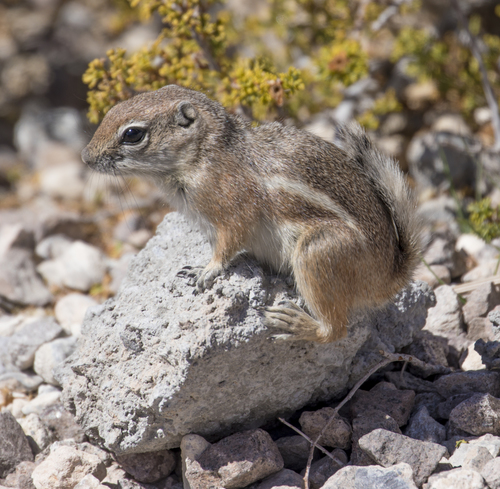
Palmer's chipmunk (scientific name Tamias palmeri (Merriam, 1897)) has solid black and white stripes running down its dorsal body, matching the pattern of other chipmunks. Its body is tan, with a paler ventral side.
Body and Tail Length
Total body length ranges from 210 to 223 millimeters (8.3 to 8.8 inches), and its tail measures 86.5 to 101.5 millimeters (3.41 to 4.00 inches). Adult Palmer's chipmunks weigh between 50 and 69.4 grams.
Geographic Range
This species is found only in the Spring Mountains of Clark County, southern Nevada.
Elevation and Habitat Type
It mostly occurs at high elevations between 7,000 and 10,000 feet (2,100 and 3,000 m), inhabiting cliffs and forested areas spanning from upper pinyon pine and juniper regions up into fir-pine and bristlecone pine communities. Palmer's chipmunk reaches its highest abundance in dense white fir and mixed conifer areas of the Spring Mountains.
Habitat Preference and Burrows
It typically prefers ground habitats rather than arboreal living off the forest floor, and can dig ground burrows around 30 feet long. There is some evidence the species prefers areas near water sources.
Temperature Tolerance
Palmer's chipmunk thrives in temperatures between 32 and 34 °C. Areas with higher temperatures are unsuitable for the species, and hyperthermia can develop at temperatures above 34 °C.
Temperature Range Constraint
This temperature limit may explain why the species is restricted exclusively to high altitude habitats. Higher temperatures limit foraging time and force these chipmunks to seek shelter for longer periods.
Temperature and Conservation Status
Extreme temperatures can limit breeding and foraging activity, which contributes to the species' endangered status.
Diet Resources
Stored food caches of Palmer's chipmunk often contain ponderosa pine seeds, which are an important food resource for the species. Palmer's chipmunk is omnivorous; it is known to eat local fruits, grass, insects, fungi, and seeds from other conifers.
Ecological Role
The species plays a key role in seed distribution for trees and other native plants.
Hibernation Behavior
It hibernates in underground burrows during cold weather, but it is not an obligate hibernator. On warm winter days, Palmer's chipmunk will leave its burrow to access stored food from its caches.
Predator Species
Palmer's chipmunk is a primary prey species for multiple predators in its native habitat. Common predators include red-tailed hawks, rattlesnakes, coyotes, raccoons, long-tailed weasels, and feral cats and dogs.
Group Foraging Behavior
Palmer's chipmunks have been observed foraging in groups. In these groups, some individuals forage and feed while others monitor for predators or other threats to assess risk.
Anti-Predator Communication
The chipmunks chirp to signal to one another when a predator is nearby. This group feeding behavior means Palmer's chipmunks have higher survival rates when living in larger groups, as they can warn each other of danger.
Nest Location
Nests are most commonly built on the ground, usually underground within burrows, but they can occasionally be found in trees.
Mating and Litter Birth Timing
Mating occurs such that litters are born in late spring to early summer. Females give birth to litters of 3 or 4 hairless pups.
Pup Early Development
After around one month, the pups have developed a full smooth fur coat and begin moving in and out of the nest. At about 6 weeks old, the pups emerge from the nest and shift to a mostly solid food diet.
Pup Maturation
Pups mature quickly and can be independent by the end of the summer. They reach sexual maturity at around 10 months old.
Breeding Frequency and Parental Care
Palmer's chipmunks typically breed once per year, and only females care for the young.