About Marmota baibacina Kastschenko, 1899
Taxonomic Identity
Gray marmots (Marmota baibacina Kastschenko, 1899) are one of the largest marmot species native to the Palearctic.
Typical Weight Range
They typically weigh between 4 and 6.5 kg (9 to 14.5 pounds), with some individuals reaching nearly 8 kg (18 pounds) just before hibernation.
Body Size Variation Factors
Their body size varies based on the time of year relative to hibernation, as well as latitude and elevation; overall, body size increases at higher latitude and elevation, and decreases at lower latitude and elevation.
Hibernation Weight Loss
Gray marmots can lose up to 30% of their total body mass during long seasonal hibernation.
General Body Form
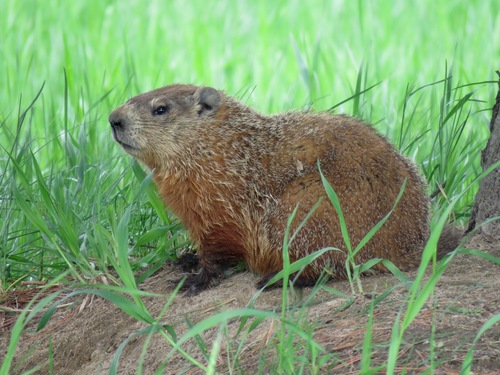
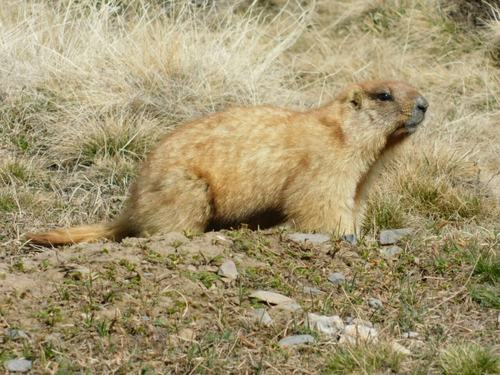
Their bodies are short and stocky, with strong limbs and short tails.
Total Body Length
Total body length, which includes the 13 to 15 centimetre (5 to 6 inch) tail, ranges from about 60 to 80 cm (25 to 30 inches).
Limb and Digit Structure
Their forefeet have 4 digits with strong claws suited for digging, while their hindfeet have 5 digits.
Dorsal Fur Coloration
Their dorsal (back) fur ranges from beige to tan, with brown to black hairs or hair tips blended throughout that gives the coat an overall gray appearance.
Ventral Fur Coloration
Their ventral (belly) fur is a more orange-reddish brown.
Tail Coloration
Their tail matches the body coloration for most of its length, but ends in a dark brown to black tip.
Facial and Head Features
Gray marmots have small, round, light-colored ears. Their cheeks are darker brown, while the area around their mouth is a lighter yellowish brown.
Color Anomaly Record
Albinism has been recorded in this species.
Sexual Dimorphism
Gray marmots are not known to show sexual dimorphism (physical differences between males and females), though adult males are larger than adult females in most other marmot species.
Gland Presence
They also have both cheek glands and anal glands.
General Habitat Type
Gray marmots inhabit mountain meadows and steppes.
Diet Composition
They forage on sage bush in spring, and on grasses and flowering plants in summer and fall.
Elevation Range and Slope Preferences
They occur at elevations from 150 to 4,000 m (490 to 13,120 feet), and tend to prefer mild to moderate, well-draining slopes with suitable soil for digging burrows; suitable soil ranges from fine-grained soft soil to soil that contains sand or pebbles.
Native Distribution Range
Their native distribution extends from the Altai mountains of southwestern Siberia (Tuva, Russia), western Mongolia, northwestern China (Xinjiang), and eastern Kazakhstan, into the Tien Shan mountains of northwestern China, Kyrgyzstan, and southeastern Kazakhstan.
Low Elevation Range Extension
In southeastern Kazakhstan and southwestern Siberia, their range extends into lower elevation dry steppes.
Introduced Population Location
The gray marmot is an introduced species in the Caucasus mountains of Dagestan, Russia.
Sympatric Species Overlap
In the Altai mountains of western Mongolia, the gray marmot’s range overlaps with the range of the Tarbagan marmot (Marmota sibirica).
Interspecific Competition Effects
In this zone of overlap, competition from Tarbagan marmots restricts gray marmot habitat to elevations above 3,000 m (9,800 feet) in areas with scattered boulders and rocks.
Hybridization Occurrence
Observations of hybridization between the two species, and of the two species living in the same area, are rare.
Mating Timing and Location
Gray marmots mate in early May, often mating inside burrows before they emerge from hibernation.
Mating System
Their mating system may be either monogamous or polyandrous.
Gestation and Litter Size
Gestation lasts 40 days, after which females give birth to litters of 2 to 6 young.
Female Reproductive Maturity
Female gray marmots reach reproductive maturity at 2 to 3 years old.
Reproductive Frequency and Adaptations
Females reproduce in alternate years, and will reabsorb embryos when environmental conditions are harsh.